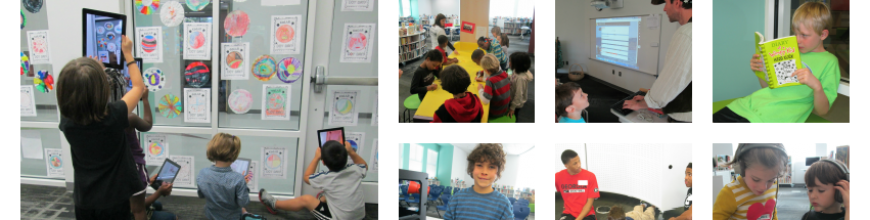

One of my goals this year in our library is to foster global thinking and global collaboration. To connect with these types of opportunities for our students, I seek out connections on Twitter as well as in Google Plus communities such as GlobalTL and Connected Classrooms. I also offer opportunities within the projects taking place in my own school for other people around the world to join in.
This summer, I became involved in a conversation with Joyce Valenza, Shannon Miller, and Paul Fleischman about how books could live beyond the closing of the cover. What if a book inspired us to take action in the world? What would those actions look like around the globe? How could they be documented? How could they be shared? What would it look like if the author engaged in conversations about the actions being inspired by the book?
This September, Paul Fleischman’s book Eyes Wide Open: Going Beyond the Environmental Headlines was published. It’s a different kind of book because it doesn’t give our young people a prescriptive list of answers to solve the environmental problems of the world but instead to take an inquiry stance. It inspires our young people to listen closely to the environmental stories being shared about our world and to uncover stories of their own. It calls our young people to take action on those world problems and realize that even at a young age they can make a difference in our world.
Joyce Valenza wrote a great post about the book. In it, she included Paul’s voice about his book.

About Eyes WIDE Open:
We’re living in an Ah-Ha moment. Take 250 years of human ingenuity. Add abundant fossil fuels. The result: a population and lifestyle never before seen. The downsides weren’t visible for centuries, but now they are. Suddenly everything needs rethinking–suburbs, cars, fast food, cheap prices. It’s a changed world.
Eyes Wide Open explains it. Not with isolated facts, but the principles driving attitudes and events, from vested interests to denial to big-country syndrome. Because money and human behavior are as important as molecules in the environment, science is joined with politics, history, and psychology to give altitude on this unprecedented turning point. It’s a time of bold advances and shameful retreats, apathy and stunning innovation.
What better time to have our eyes wide open?
An Eyes Wide Open Google Plus Community has been established to make connections for global collaboration around the book. Paul Fleischman has also created a site to house headlines, projects, and conversations about the book. He wants this to be more than a book that you read and close, but instead for it to be a book that inspires action in the world.
Also from Joyce’s blog, there’s a great list of ideas of how you might use Paul’s book with students.
What sort of reports might students contribute?
- Take photos (and create a gallery) that document population rise or consumption levels or innovations being used to address these challenges. Attempt to document how your eggs, milk, farmed fish, and meat are made.
- Make a video describing a local citizen science project. Document a plastic bag banning campaign, a local pollution issue, or your own attempt to go vegan for 30 days.
- Interview someone in city government connected with water, transit, city planning, or emergency services. Or a biologist, park ranger, or science teacher. Or a religious leader whose church has taken a stand on the environment. Or your state senator, state assembly representative, or an aide to your congressperson. Or fellow students or neighbors to get a sense of how average citizens view the situation. Google+ Hangouts might be a perfect venue for archiving these interviews!
- Write a description of one of your area’s key issues and how it’s being dealt with. Join with one or two others, each tackling one part of the project: research, interviewing, editing. Would your local newspaper be interested in the result?
- Do a survey of your city, finding out where your water comes from, how your electricity is made, where your trash goes. Prepare to make many phone calls and to ask follow-up questions. More fun with a friend.
- Annotate local newspaper stories, adding commentary that lets us see how the global trends and mental habits described in the book are playing out locally. Feel free to refine my thinking.
- Remix media and create digital stories around an area of local interest.
- Inspire a meme to invite continual, global reinterpretation around an environmental prompt
- Submit a field report. Work prepared for school assignment is fine. Take time to review and revise. Once you’ve posted it on Google Docs, YouTube, or another platform that all can access, send a description to [email protected]. Include a bit about yourself, how you came to the topic, and a photo of yourself or something connected to the report. If Paul finds it well done, he will add it to the roster, put a pin in the map, and maybe even give it a shout out in his blog.

Connected librarians have a huge opportunity with this book and the many communities that are available to us. We are the people within our buildings who work with every student, teacher, and family member within our school. If we collaborate, then we connect our entire school communities with one another.
November 15 is America Recycles Day. The week of November 10-14 would be a great week for us to begin to connect our voices with one another around an issue that really affects us globally. Paul’s amazing book Eyes Wide Open could be a piece that we could use to spark conversations around the globe. It could also be paired with a plethora of other picture books and informational texts on environmental action. More than a conversation, our connections could push our young students to take action in our world, and those initial connections could lead to a continued connection between schools around the world in the name of environmental action.
Here’s what I hope to do:
- Connect with schools throughout the week of November 10-14 via Skype or Google Hangouts
- Read an environmental text together
- Have each school identify and explain an environmental issue in our school or community. For us, it will most likely be the amount of waste being thrown away in our classrooms.
- Have each school exchange their issue and brainstorm possible next steps for one another. Wouldn’t it be nice to hand your problem over to someone for a few minutes to see the problem through their eyes? That perspective might be the very thing you need in order to take a next step in your problem.
- Share our brainstorming with one another and document suggestions in a digital format such as a Google doc or Padlet.
- Commit to reconnect at some point to share what actions we have taken, what has been successful, or what new problems have surfaced.
http://bit.ly/americarecycles14
Let’s do more than just connect our students for a day. Let’s connect our students to work on an issue that has an impact on our world. As part of Connected Educators Month, let’s start thinking of how we can connect our students in meaningful ways throughout the year and begin planning those connections now.
As you make connections, create action steps, and make an impact on your world, share it!
Eyes Wide Open hashtag: #ewopf
America Recycles hashtag: #americarecyclesday
GlobalTL hashtag: #globalTL
and don’t forget #tlchat


