International Dot Day is one of our favorite days (weeks) of the year. It gives us permission to be creative and see what we can do just by making a mark. It also connects us with so many classrooms around the world. Classes are always looking to connect on this day, and we have made many collaborative relationships with schools because of this one day of the year.
This year, we used Dot Day as a way to explore our goal of dreaming, tinkering, creating, and sharing. We explored Google Drawing, which was a new tool for most students. We used Dot Day as a time to tinker and see how Google Drawing functioned as well as how to collaborate on a drawing with another student or class.
We also used colAR mix again this year to make augmented reality dots. This year, I encouraged students to think more globally as they made their dots by embracing the them of “making your mark on the world” that is the essence of The Dot. Students were encouraged to design a dot that represented their talents, hopes, dreams, and passions. I loved this new twist on a tool that we used last year because it revealed so many stories from students. One student drew a picture of an airplane flying through the clouds because of his dream to be a pilot when he grows up. Another student drew an astronaut and UFOs because of his desire to explore space. Another drew her whole family because they are what she loves in life. Some students chose to highlight their creativity as a way that they make their mark by designing unusual dots with their favorite colors. These were empowering stories because they allowed students to have a voice to share something personal about themselves in a way that they might now have shown before.
One amazing thing that happened while students were using the colAR app was how they discovered different ways to scan their dot. It started out as what some people might see as a mistake. A student’s hand was on top of their dot while they were scanning their image, and the hand became a part of the rotating sphere on the iPad screen. This resulted in an uproar of excitement as sharing began and the idea spread like wildfire. Soon students were trying to put their faces on their spinning spheres. Others stacked towers of crayons on top of their dot and tried to see if that would scan into the 3D image. All of this happened because of an opportunity to tinker. When we give kids a space to explore, they figure out amazing things and they willingly share and teach others what they learned. They get excited about their learning and they want to do more. I bet that these students would have spent an extended period of time continuing to experiment with colAR mix to see what else they could figure out, and they would have done this without getting tired or bored. These are the things that days like Dot Day reveal.
We had numerous Skype connections. Each one had its own unique twists and conversations between students and teachers. In many of these Skypes, we collaborated on a Google Drawing dots after reading the book. This included dots with our friend Okle Miller in Tampa, Edie Crook in North Carolina, and Crystal Hendrix in North Carolina (just to name a few). Sometimes this was live during a Google Hangout or Skype and other times it was after we disconnected. One of our hangouts was a large hangout between Matthew Winner in Maryland, Nancy Jo Lambert in Texas, Donna MacDonald in Vermont, and Esther Uribe in Texas. It was fun to read The Dot to students in so many states at one time, but what was even more fun was drawing with all of them at the same time! We definitely did some tinkering with this one. Many of us learned of the challenges of younger students but found ways to involved them even with computer-use difficulties. The students loved seeing drawings “magically” appear on our shared dot.
Our multi-school collaborative dot
With Jennifer Reed in Massachusetts, we accidentally deleted all of our work on our collaborative dot. The kids were in a panic, but it was a fantastic opportunity to do an impromptu lesson on the power of revision history in Google Drive. We were able to recover our work and learn an important trick. We even talked about how revision history is one way that work is never deleted, which can be a positive but also a negative if you have written something that you wished you hadn’t.
Mrs. Clarke’s class had a Skype connection, but we weren’t able to do a collaborative dot with our connecting class. Instead, we split the class in half at our 2 projection boards and they created a dot together as a class. They got just a bit competitive as they tried to cover up each other’s work, but even this was a great opportunity to talk about how to work with others on a doc without being disrespectful of the contributions.
Mrs. Clarke’s class competitive dot
Some classes that we connected with had already spent a great deal of time being creative, and they shared with us dots that they are going to physically mail to us. Jenny Lussier in Connecticut had colAR dots as well as Morse code greeting cards. We can’t wait to decode what they say! We also discovered with Jenny that there’s more than one version of The Dot floating around out there.
It has been fun to discover today that The Dot has different words depending on the version of the book you have! #dotday@peterhreynolds
Cathy Potter’s students in Maine read the book Ish to our students and shared their own illustrations for the book. We had a great conversation about the connections between both books.
Students and teachers alike love this day, but I do leave this day with a wondering. I’m thinking so much this year about global thinking and global collaboration. This day is filled with thousands of Skype and Google Hangout connections around the world. We connect. We read. We dream. We create. But then what? We leave one another until the next big event. I’m by no means being negative about Dot Day. I’m a huge advocate, but I do wonder about why we don’t build upon these connections we make. If we are really going to “make our mark” on the world, shouldn’t we be taking some actions together beyond connecting, reading, and creating? I would like to gently nudge us all to think about this. I’m just as guilty. I connect every year and then I move on, but I can’t help but carry this on my mind, reflect on it, and consider what more we might do beyond today. Think with me! Let’s keep our dots connected.
On June 25 and 26, 2014 I had the honor of attending the Google Teacher Academy in Atlanta. It was a long road to get to GTA. The application process is a test in how well you can boil down your practice into the most concise wording and video that represents your innovation and reach. The application is short with only a handful of questions that limit your response to 800 characters. One of the most challenging parts of the application process is the video. In one minute, you have to introduce yourself and show how you foster innovation in education as well as how you have a global impact. I don’t even know how many hours it took me to craft a one-minute video, but I do know that the process forced me to really think about my practice. I made multiple versions of the video and got feedback from multiple including Cat Flippen, #GTACHI. Here’s how it turned out:
The wait to find out if I got into GTA was agonizing. I won’t lie about that. Even though I had IFTTT recipes setup to notify when the email came, I still stayed glued to my phone and computer because I was in a professional learning session on announcement day. Once the email came, things started happening fast. The 35 were invited to a Google Plus community where we could begin connecting. It didn’t take long for the collaboration to begin. Here are just a few things that happened:
Jennifer Armstrong began making a Youtube playlist of our GTA videos
I created a Google doc where we could begin crafting a shared blog post that we each could share in our own networks to introduce the 35 #GTAATL participants
Linda Humes and Corey Holmer started designing a t-shirt for us. Corey’s design was ultimately chosen, but many people in the group contributed ideas. Frank LaBanca ordered our shirts and had them all shipped to me in GA so that I could easily drive them to GTA rather than someone having to bring them on the plane
Renee Nolan organized a meetup for most of us on the night before GTA began to get to hangout together before GTA consumed our brains
Janna Gibson made a guide to Atlanta to introduce everyone to the food and sights to check out in Atlanta
And the list goes on
I loved this because it brought out one of the things that inspires me about collaborating. We all have talents and expertise, and so many people stepped up to share their talents and passions with the group.
Finally meeting everyone face to face was so much fun. We only knew one another from our profile pics, social media posts, and blog stories. We all met at Marlow’s for dinner the night before GTA and spent time just having conversation and sharing the anticipation of what the next two days would bring.
We arrived at the Google office and waited until the exact time to enter. After checking in, we were immediately launched into the Google culture, which of course started with food. We had a great breakfast before moving into our agenda.
I won’t detail the entire agenda, but share some of the things that stood out to me along the way.
First, the planning team revamped the entire agenda, and we were the first GTA cohort to try out this new agenda. This was exciting but also a little risky since it meant that we might not experience what we thought we were going to experience. What I saw was that the agenda focused a lot more on philosophy than on specific tools. The idea behind this is that tools come and go and tools change, but if you have an innovative, risk-taking philosophy of teaching, then you adapt to new tools and environments as well as create entirely new environments for you and your students.
We watched the Moonshot Thinking video, which I had seen at a GAFE Summit. It is always powerful no matter how many times I watch it.
I loved how this framed our entire GTA experience because it set the tone that we as innovators in education we need to be trying things that have never been tried and creating new tools and experiences for our students that stretch far beyond a “next step”. I loved how this moonshot thinking and “solving for x” brought us into our first experience at GTA.
This was probably my favorite “activity” that we did over the 2 days. Prior to GTA, each of us submitted what we felt were our biggest challenges in education. Those challenges were compiled into themes. At our tables, we were randomly assigned one of the challenges. Then, one of our team members had to spin a wheel filled with tech tools. Our goal was to use this tech tool to address the specified challenge, and to make things interesting, we only had 5 minutes to make a decision.
My group ended up with “lack of teacher training” paired with “Panoramio“. Most of us in the group had never used Panoramio, which was perfect! I felt like it put us in the shoes of our teachers who feel insecure when facing a new technology tool. I was reminded of teachers who feel frozen when they face the unknown and want someone to just tell them exactly how a tool works before they will try it. With the clock ticking, we didn’t have that luxury. Instead, those of us that had used the tool began brainstorming how Panoramio could address teacher training. Others, like me, frantically researched the tool to see what it was capable of. At a glance, Panoramio is a collection of photographs uploaded by the community of users and embedded onto Google Maps by location. You can browse the photographs by location or you can specifically search for topics of pictures. For me, I was trying to figure out if you could tag images and search by tag. From my own experience, I’ve seen the lightbulb go on so many times for a teacher when they see something put into practice in a classroom. Sometimes all it takes to help a teacher feel “trained” enough to try something is just seeing what it looks like in a classroom. I thought that if we could create a massive social media campaign for educators to upload images of their classrooms into Panormaio and tag those images by the topics that they showcased, then we could support teachers in “seeing” what that specific topic looked like in a classroom. If we needed specific kinds of pictures uploaded to Panoramio, then we could be specific like pictures of students using social media in the classroom. I added this thinking to my group, but I loved that others in my group had completely different ideas for how this tool could be used. This exercise also reminded me that our focus can’t be on the tools. Our focus should be on our students, teacher, families, and community along with the needs that they have. There’s a whole range of tools that can support those needs. If we push our thinking and try something radical, sometimes a tool that seemed like the most absurd idea for solving the challenge actually leads to something innovative.
Our day was of course surrounded by snacks. We had official breaks, but drinks and snacks were always within reach.
Even breaks to the bathroom kept you learning and surrounded by Google culture.
Throughout the 2 days of GTA, there was time for “inspiring ideas”. These were short presentations from various members of GTAATL. We submitted ideas before GTA and were selected by the planning committee to present. I was the very first one to share, which was a bit intimidating. I shared various ways that I empower student voice through Google forms as well as how Google forms can help you crowdsource information.
Other rockstars included Chris Aviles, who shared how he gamifies his classroom. He has created an entire story line that plays out with his students which even includes getting phone calls from game characters using Google Voice. Amy Burvall shared how she used Google Plus to give her students a space to contribute to the classroom and crowdsource information. She also uses this tool to connect people in her professional development sessions. By doing this, people aren’t sitting passively in her sessions, but are instead, actively contributing during her session and beyond. Genius! Hearing from all of these amazing educators during this session was an energy boost during an exhausting day. I was proud to be a part of this group.
One of the things that I hoped would happen was a preview of Google Classroom. We heard about the process it took to develop Google Classroom. I loved seeing a picture from an elementary teacher’s classroom where she had posted about 7 or 8 steps it took to turn in an assignment to the teacher. This was one of the inspirations for Google Classrooms. We had a chance to try out the interface and were all excited and blown away by the usefulness and simplicity. With 35 innovative educators in one room, it didn’t take long for a range of questions to surface. We definitely surfaced some barriers that people may face in using Classroom, but overall the buzz was one of excitement and eagerness to get this tool in our teachers’ hands.
Our lead learners
The rest of GTA involved 4 rounds of explorations of various Google tools and themes. We grouped ourselves into these rounds by common interests in the kinds of challenges we wanted to tackle in our action plans.
We saw a lot of tools, but didn’t have time to use them very much. Now that I’m away from GTA, I’m starting to look at what I saw and consider how these tools fit into what I may try in the library this year. I’m already thinking about how Google Draw can be used as we connect with other schools via Skype and Google Hangout. I wish that we had spent more time with the various map tools from Google because I think there is a lot of potential with those as well for global collaborations. I’ll have to take time to do this for myself.
At the end of day one, we all became Google Certified Teachers. We had a pinning ceremony and a celebration dinner. It was a great sense of accomplishment, but it was only the beginning of the work and opportunities ahead.
Day two was time for us to explore our own interests through an unconference as well as work on our action plans. After GTA, it is an expectation that you create an action plan to facilitate change in education during the coming school year. My focus is on global collaboration. Seeing what students gain from connecting with authors, experts, libraries, and classrooms beyond our walls has convinced me that I need to develop even more opportunities for students to have these connections. This year, I want connecting to be more than a one time thing. I want to create content with students in other states and countries. I want students to offer one another feedback and ask one another questions. I want students to have an opportunity to create projects that matter to them and share those with a global audience.
Amy Burvall inspired many conversations about hashtags and “showing your work”.
I had many important conversations during GTA about this project. Amy Burvall and I talked a lot about hashtags and how tags are the “soul of the Internet”. She helped me to think about how we track our work so that it continues to inform our next work. We talked about the importance of sharing the whole process of a project and not just the final project. This is the kind of thing that GTA does. You may not get to know every single person at GTA, but you make connections with people that you know are going to continue to push your thinking well beyond the 2 days that you spend together.
Now my attention turns to GlobalTL, a Google Plus community that was started by Joyce Valenza. Now, I’m working along with Joyce and many other librarians to develop this community that will facilitate global connections. I know that by connecting and collaborating with librarians, I am connecting my students and teachers with students and teachers around the world. Librarians work with every student, teacher, and family member in the school. I think it makes sense to think about how to create a community that connects people. We don’t know exactly what will happen in the group, but we are going to shoot for the moon to foster global collaboration.
Google Teacher Academy has connected me with 34 other amazing educators, and I know I can call on them for any questions or roadblocks I face. I’m also now connected to a global community of Google Certified Teachers who are actively supporting one another in their educational spaces. I’m sure that GTA is only the beginning of a long collaborative relationship with some amazing global educators.
During a collaborative planning meeting at the beginning of the quarter, 2nd grade all wanted to come to the library to learn about list poetry. We love to use the book Falling Down the Page: A Book of List Poems edited by Georgia Heard. We had a problem, though. It was hard to find a time on the calendar for each of the 4 classes to come. Rather than only serve a few of the classes or abandoning the project all together, I suggested that we use a Google Hangout to bring us all together for the same lesson and that we collaborate with one another on a Google Doc.
This was a perfect solution because it really served multiple purposes. All of these teachers were able to experience a Google Hangout for the first time. The students all heard the same information from me. All of the students saw how multiple people can collaborate on a Google doc without erasing one another’s work. It created more time on the library calendar for more classes to come for other projects rather than one project taking up 4 hour-long slots.
Yesterday, the teachers and I practiced after school for about 10 minutes. I’m glad we did this because it allowed me to work on some issues with sharing the hangout with them. I found that emailing teachers the link to join the hangout was much easier than inviting them via their Google Plus. We also had to install the Google Hangout plugin on all of their projectors. This didn’t take long, but it was much better to do without a group of students waiting.
Today, I sent out the link to the hangout. I also emailed the link to the shared Google doc so that teachers could have it pulled up on their screens. Mrs. Yawn’s class came to the library since they have a longterm sub. The other 3 classes tuned in from their own rooms. As the creator of the hangout, I had the hangout controls pulled up so that I could mute all microphones. This eliminates feedback from the projector speakers. If a class needs to speak, I (or even the teacher) can unmute the microphone. We could also communicate with one another via the chat.
I did a short mini lesson for all of the classrooms. I talked about the kinds of lists that we all make and how those can turn into poems with just a few added adjectives. I read Jane Yolen’s “In My Desk”. Then, I muted my microphone, shared my screen, and we all started writing lines to a new list poem called “Under My Bed”.
I shared the link to the document on Twitter, and we instantly had viewers watching our poem develop. This created a great discussion about how quickly something that is posted on the Internet can be seen because we literally had 8 viewers the second that I pressed “tweet”. Many more viewers came in and out of the document while we worked. The kids really liked knowing that they had an audience watching their poem come to life.
The students also loved watching the lines magically appear on the screen from all of the classrooms.
At the end, I called us all back together and read the poem aloud. It was amazing to hear how creative their lines were! To close, I invited students to spend some time in their classrooms revising the poem. There were several lines that were very similar so it was a natural follow-up to spend time deleting or combining lines.
Many students seemed interested in writing this kind of poetry in for our media center poetry contest. Students have 2 more weeks to submit a poem. I’m sure I’ll be reading several more list poems in the future. Here is our poem as it looked at the end of our hangout:
Under my bed
you will find…
Three old pacifiers from when we were babies.
Two pairs of stinky, dirty socks from my last soccer game.
A box of last years Christmas wrapping paper.
Last night’s dinner that I didn’t like.
My little brother.
A pair of destroyed Jordan’s.
My shiny diamond.
A toy skeleton that I bought last year for school.
Old, yucky trash.
A little brown shoebox with really old seashells.
My tiny puppy.
A Kidz Bop 25 CD.
Motorcycles, cars, crayons, American Girl Dolls, and stuffed animals.
A peach, toy train track,
Hidden laundry like dirty jeans and shirts.
New, blue jewelry I just bought.
Cheetah printed sneakers.
A very old picture of a dog I drew.
Old chewing gum.
Brown Pokemon cards covered in dust.
moldy, blue roller skates that don’t fit anymore
thousands of stuffed animals that belong to my dog
three feathery pillows that my dog chewed up
a beach ball that popped on a pointy shell at the beach
old shark teeth that are at least 500 years old
nasty, dead cockroaches smooched onto the floor
old baseball cards
five old socks, moldy carrots and clementines, and an old water bottle
muddy shoes from playing outside on the last rainy day
a scratched torn up bookbag that my cat ripped apart
a wrinkly gum wrapper
the teeth that I lost in kindergarten
some thank you cards I was supposed to send to my relatives last year
Yesterday, I posted about our annual Poem In Your Pocket Day Cafe. Today, 13 more classes came to share poetry into our open microphone. It was a non-stop day filled with wonderful words. As usual, there were many special moments like a student sharing a poem in Chinese and having his class give him the biggest round of snaps I’ve ever heard. Listen to their poetry sessions at the links below.
We loved having special guests join us online today:
Jovette Francoeur, educational consultant in Montreal, Quebec.
Grandparents in Goshen, CT
Mary Morgan Ryan, librarian in Illinois
Grandparents from Illinois
Kevin & Diane Fuchs, uncle & aunt from Indiana
Grandparents in Florida
Friends in Boston
Mrs. Hinger, librarian at Clarke Middle School in Athens
And so many more.
Each year, this day holds many special memories for it. Each year we add something new. I would love to hear your ideas for how this event could grow and change next year.
Each year during national poetry month, we host a live poetry cafe in the library. This event has grown from 1 day to 2 days. It is our way of celebrating National Poem in Your Pocket Day, even though it usually falls on a day other than the national celebration. Across the 2 days, every student in the school comes to the library to read poetry into our open microphone.
The tables are set with tablecloths, lanterns, flowers, and some paper flowers, too.
Each year, we try to add something new. This year, we added some cozy seating among the tables so that students could feel a bit closer to the student reading his or her poem.
This year, we also used a Smore to promote the event and keep everything collected in one spot. The Smore held our schedule, link for logging in to watch the poems, pictures from the event, and links to the videos once they were recorded. I also loved that the analytics in the Smore allowed us to see all of the places that our event was being glanced at.
This year, we also added Twitter to the mix by generating our own hashtag #BarrowPoems
I used Twitterfall to display the tweets coming through, and the students loved seeing each and every one. Sometimes I would take a comment out of the chat and tweet it for visitors who didn’t use Twitter themselves. It was so much fun for the students to know that some of our familiar friends from World Read Aloud Day were watching at times during the day. Okle Miller (Florida) and Donna MacDonald (Vermont) tuned in to listen. We also had a library from Rhode Island join us too.
It was a lot to manage all by myself, but it was fun. It is truly amazing to watch almost every student in the school get up in front of their peers and share poetry. It was also inspiring to watch as students stood with their peers who were nervous about sharing.
I hope that you have a few moments to listen to some of the poetry sessions below and share them with friends, families, and students around the world.
The official National Poem In Your Pocket Day is April 24 this year. Since this date is mixed into our state testing days, we celebrate a bit earlier at Barrow. Over the past few years, Poem In Your Pocket Day has grown into a 2-day event in our library. Every class comes to the library across 2 days. I setup the library like a coffee shop or cafe with a poetic atmosphere: tables with colorful tablecloths, lanterns, lighting, and a microphone. Each student steps up to the microphone to share an original or a favorite poem and we celebrate each poem with lots of finger snaps.
Also each year, we have been broadcasting our poetry reading live via Adobe Connect. This year we will continue this tradition. I’ve created a Smore to show our schedule and to have access to the login link.
To view our poetry readings, you simply visit the Adobe Connect link and sign in as a guest. You will see students reading their poetry and also have a chat window to leave comments for them. To spread the love of Barrow poems to the world, we also encourage you to tweet about our poetry using the hashtag #BarrowPoems We invite you to tune in to some or all of our readings. The schedule is packed for 2 whole days. Our students love knowing that they have a global audience listening and celebrating their poetry. We will see you next week!
Back at the beginning of the new year, my friend Shannon Miller in Van Meter, IA told me she was planning to do a research project that involved Rainbow Loom bracelets. When she started implementing the project in her library, it organically grew into something much larger. Through connections with In This Together Media , the project developed into “Banding Together”. You can read the full details of the project here: https://www.smore.com/n65m
Here are the basics:
Students at Van Meter, Barrow, and multiple schools around the country are making Rainbow Loom bracelets.
The bracelets will be sent to a school in Mangalore, India
Along with the bracelets, we will send poetry written by students, 3D printed charms designed by students, and a disposable camera to take pictures to send back
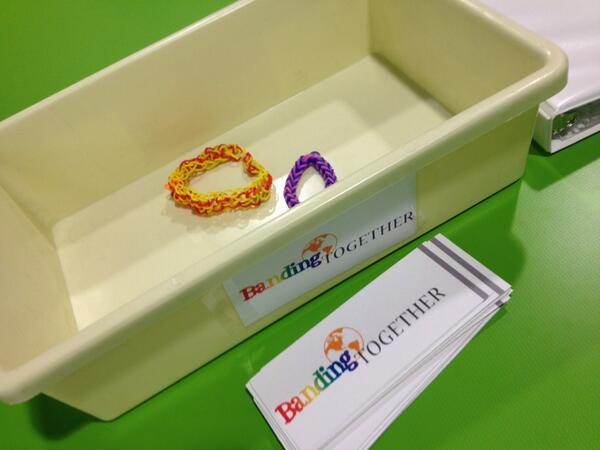
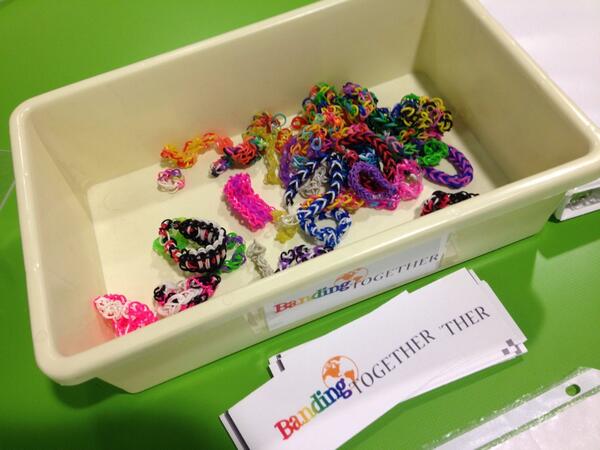
I announced the project this week on our morning BTV. I placed a collection box for Rainbow Loom bracelets on our circulation island, and by the end of the day, a few bracelets had already been donated. Students asked me about the project all day. By the next day, several kids were bringing bracelets in. I was so surprised by the generosity and enthusiasm from the students to send their bracelets across the miles.

First Day
Second Day
Next, we started designing charms for 3D printing. I had already experimented some on my own, and I sent Shannon Miller a file that I made so that her students could print it and learn from the file too. Her students took my file and modified it or examined it in order to design their own.
Shannon’s students in Iowa being inspired by the file I sent them
I have a group of 5th graders who have been exploring different technology and how they might support other classes trying to use that technology. They have already been exploring Tinkercad to design objects for 3D printing, so I knew they would catch on fast to the idea of making charms.
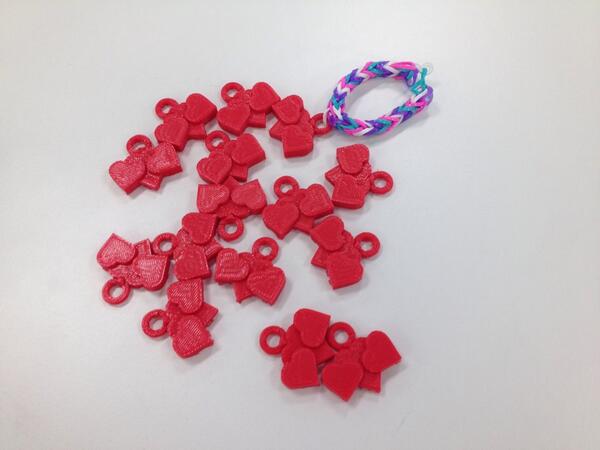
Since the Banding Together project has a lot to do with spreading the joy in our hearts, we have focused our charm design on that theme. We decided that each charm should have some kind of heart. Dmitri designed a heart with a heart hole in the center. Walker designed a charm with the word “love”. Instead of an “o” he used a heart. I designed a triple heart to symbolize India and the US uniting together with our shared joy. We took these first 3 designs and made sure that they printed correctly. Once we saw how they worked, we started mass production.
As charms were ready, parent volunteers helped put them on bracelets. Dmitri and Walker also became quality control and made sure that all of the Rainbow Loom bracelets we were sending had joy-filled quality. They continued attaching charms.
We are waiting on a few more designs to be completed and we will ship our first batch of bracelets and charms.
Next week, we are adding a new layer onto the project with poetry, so look for an update soon about this exciting development that our 2nd graders will be involved in.
I love how this is a project that students in all grades can be a part of whether they made bracelets, wrote poetry, designed charms, or helped with packaging and quality. We truly are banding together in more ways than one.