Back in October, our 3rd graders spent time studying the illustrations of Jerry Pinkney. They paid close attention to how Pinkney told the story through his illustrations in preparation for a field trip to the High Museum of Art in Atlanta to see the exhibit Witness: The Art of Jerry Pinkney. You can read more about that here and here.
Over the past few weeks in art, students have been working with the text of a folktale to create their own visual interpretations of the text. Mrs. Foretich, the art teacher, spent a lot of time exploring and researching the vocabulary within the stories with the students so that they would be able to paint an accurate interpretation. Each class chose and different folktale and each student in the class was assigned a piece of text from the story.
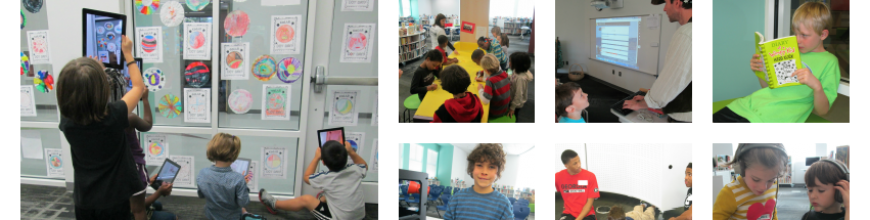
Once the paintings were ready, Mrs. Foretich organized them in the order of the story and gave them to me. Students came in small groups to record the text for each illustration on the iPad. We used iMovie to put all of the clips together.
This past week, third grade held a parent breakfast where families were able to come to a viewing of the final products. They were also uploaded to Youtube for families who were unable to attend.
You can enjoy their visual interpretations below. It was fun to watch the students take on an artists eye and think like a published illustrator thinks. Often, illustrators receive the text to a story with no other feedback. It is up to them to take these words and translate them into illustration. This project gave students a better understanding of the fun and the challenges of this process.
Today was step 2 of our 3rd grade folktale project, and it was a big step. We traveled to the High Museum of Art to see the exhibit Witness: The Art of Jerry Pinkney. Prior to going, we spent time exploring all of Pinkney’s books in our library collection. Mrs. Foretich, the art teacher, also did a lesson on museum etiquette.
On the way to the High, students explored Pinkney’s books some more. As we neared our destination, I asked a few students to think about what they might like to tweet about the books or their excitement for the exhibit. Our plan was to use twitter throughout the trip to document some of the things we saw and the things we learned. We used our school hashtag #barrowbuddies to tag our posts.
After arriving, our groups split in half. Some toured the exhibit, whiles other ate lunch. Then we switched. Some of us were also able to explore some of the permanent collection before our tour began.
The tour of Witness: The Art of Jerry Pinkney was done by a docent. We received a brief history of the museum before entering the exhibit. Our docent had us sit in front of collections of paintings and told us about the stories that the paintings came from. We saw paintings from historical books such as Minty and Black Cowboy Wild Horses, folktales such as Three Little Kittens, Rikki Tikki Tavi, Little Red Riding Hood, and The Little Match Girl, and biblical stories such as Noah’s Ark. Our docent had the kids work together to retell some of the familiar folktales as she pointed out things in the paintings. We noticed how Pinkney set The Little Match Girl in New York City rather than in Europe where the tale came from. We noticed how Pinkney set Little Red Riding Hood in a wintry woods so that it made sense for her to wear the kind of cloak she was wearing. Along the way, we also learned about Pinkney’s childhood and how he always had access to a pencil and art supplies. As we studied the watercolor paintings, we were reminded of the difficulty of working with this medium and the need to work quickly before the colors run together. At the close of the exhibit, we looked at The Lion and the Mouse. Along with looking at the paintings, students got to do some impromptu storytelling of their own using puppets.
The finale of our visit was getting to hear some of Pinkney’s folktales come to life through the storytelling talents of a rambler from the Wren’s Nest. We heard 2 folktales, and the students were heavily involved in the performance. He had them hanging on every word.
Our field trip allowed us time to do a brief second stop at the Georgia State Capitol rotunda. Although students didn’t get to tour the entire Capitol, they at least got a frame of reference for the Capitol as we study it back at school. We plan to use the Georgia Capitol Tour App on our iPads to do a more in-depth look at this landmark.
Once again on the way home, students took another look at Pinkney’s books with a new appreciation for the artwork that spans the pages of this books. It was truly awesome to stand in a room surrounded by the collective work of Pinkney. We did not have enough time to truly appreciate the years of work that went into this collection, but we will return to our school with a new appreciation of his art.
Our next steps will be to:
Continue reading folktales and studying their elements
Identify one folktale for each class to read without seeing the illustrations
Create the illustrations for the folktale in art
Put illustrations and text together with our iPads
Third grade is beginning a folktale project that is a collaboration between classroom teachers, the art teacher, and the media center. This week, we kicked the project off with a lesson in the media center to explore the artwork of Jerry Pinkney, who writes and illustrates many folktales.
Students came to the library during art. The purpose of this time was to get familiar with Pinkney’s illustrations before students take a field trip to the High Museum of Art in Atlanta to see an exhibit of Jerry Pinkney’s art. We wanted students to think about 2 questions.
What clues does the illustrator give us about the setting of the story?
What clues does the illustrator give us about what the characters are doing in the story?
We started with this video of Jerry Pinkney discussing The Lion and the Mouse.
After the video, I asked the students how Jerry Pinkney started working on the book and what he realized once he made those first steps. This took our conversation to focus on the importance of illustrations and how they can tell the whole story or how they can work with the text to tell the story.
Next, we looked at this slideshare that showed Caldecott honor and medal winners along with the criteria used to decide the winners.
The purpose of this part was to highlight the many ways you can look at an illustration and how it interacts with the text or tells the story. Jerry Pinkney has received several Caldecott Honor Awards along with the Caldecott Medal.
Finally, we modeled how someone might study one illustration in a book very carefully and consider our 2 focusing questions. I used We Give Books to display the book Big Red Lollipop. Students in each class noticed things such as the red cross as a symbol for a hospital, an envelope on the side of a building to show a post office, the number of buildings close together to show a town, etc. They also noticed how the character’s hair was blowing in the wind and how her leg was lifted high to show that she was running. They noticed how she was carrying a letter and smiling to indicate that she was probably going home to show her family something she was excited about.
For the last part of the lesson, students split into groups of 4-5 students. Each group received 4-5 books by Jerry Pinkney to examine. Their job was to study the illustrations using the 2 questions just like we did in our model illustration. As groups talked, the art teacher, art student teacher, and I walked around and chatted with students about what they saw in the illustrations. We then asked groups to choose one illustration that they wanted to show to another group and discuss. They used iPads to take a photograph of the illustration. When they shared with another group, they could zoom in and out of the illustration on the iPads to show the fine details.
In art, students will now have a lesson on museum etiquette where they will practice the skills it will take to visit a fine art museum.
On the trip to the High on October 23, we will tweet our observations using the hashtag #barrowbuddies.
Next steps will include:
Learning elements of folktales.
Reading multiple folktales and using a Google form to track the most common elements.
Choosing a folktale to read in class without seeing the illustrations.
In Art, developing illustrations for that folktale.
In the media center, put the illustrations and folktale version together with technology.
Share the new creation with the world
We can’t wait to see how this project develops and how Jerry Pinkney’s art inspires what the students create.
Ms. Spurgeon, a fabulous third grade teacher, does a Stone Soup folktale study with her students each year. This is a part of the folktale study that third grade just kicked off. She has her students study multiple versions of Stone Soup and consider how the characters, setting, and plot change based on where the story is taking place or which country the story comes from. Students are quickly discovering that the basic themes of Stone Soup stay the same but characters, setting, and the ingredients in the soup change.
Today, we read Jon J. Muth’s version of Stone Soup. We loved hearing the many different kinds of ingredients that were added to the soup such as pea pods, lily buds, taro root, winter melon, and more.
After we finished the story, we revisited our Google form of folktale elements to see how Stone Soup compared with other folktales we have read. We noticed that the following elements appeared in all 4 folktales that we have read in 3rd grade:
flat characters
fantasy time
setting briefly described
plot full of action
repeated phrases
Classes will continue to fill out the form and make comparisons.
To conclude this lesson, we used Tagxedo to make our own digital bowl of Stone Soup. I asked students to think about what ingredients they might add to a class stone soup if they were to go home right now and get something out of their cabinets, refrigerator, or from a neighbor. While students were checking out books, they came up to me and told me 2-3 ingredients, which I typed into Tagxedo. I selected a circle shape to represent the pot of soup, and here is what our soup looked like at the end of our time together.
Third grade just launched into a study of folktales. As a kickoff, each class came to the library for an introduction to folktales. We used a slideshare that listed many elements of folktales as well as kinds of folktales.
Then, I showed students a Google form with 3 questions. This form was displayed while I read a folktale aloud. Question 1 was the title of the book. Question 2 was a list of checkboxes that listed out all of the elements from the slideshare. Question 3 was about what kind of folktale.
At the end of the story, students paired and discussed each of the checkboxes to decide if those elements were present in the story that we read. Finally, we came back together and checked off the elements that were present in the story. Students raised their hands as I called out the elements. If we had a majority of hands, we automatically checked the box. If it was less than half the class, we stopped and discussed and voted again. If few people raised their hands, we left the box blank.
For the first class, this was the end of the lesson, but for the other two classes we looked at the summary of responses in Google forms to see what folktale elements were the most common in the stories we read. I sent the form to the 3rd grade teachers and they are going to share it with their students. A next step will be for students to read folktales on their own and fill out the form. Then, we’ll really be able to notice the trends of which folktale elements are most common in our library folktales.
One piece I didn’t incorporate into this, which would be really cool, is to insert a question about where the various folktales are from. Then, I could have embedded a gadget to put a pin on a world map (like I did in this lesson) to track where our folktales were from. This might be an addition for next year.
Each mask was created in art and is accompanied by a student-written story developed in class
As a part of 4th grade’s Native American unit, they studied folktales. They spent weeks reading a variety of folktales from around the world as well as Native American folktales. In the media center, they used Google Earth on the iPads to examine the regions of the United States where the Native Americans are found. They noticed what landforms and water features were in each area. Then, I told folktales from each tribe and they noticed how the land and regions came into each story.
In class, students continued to read folktales and examine the elements of each kind of folktale. They began to develop their own story and implement these elements into the stories.
In art, the students designed masks that accompanied their tales.
The process was long and spread out over several months, but we are excited to finally have the finished products on display in our media center. If you happen to be near Barrow Elementary in the coming weeks, feel free to stop in and read some of these stories and examine the beautiful masks.
 Back in October, our 3rd graders spent time studying the illustrations of Jerry Pinkney. They paid close attention to how Pinkney told the story through his illustrations in preparation for a field trip to the High Museum of Art in Atlanta to see the exhibit Witness: The Art of Jerry Pinkney. You can read more about that here and here.
 Once the paintings were ready, Mrs. Foretich organized them in the order of the story and gave them to me. Students came in small groups to record the text for each illustration on the iPad. We used iMovie to put all of the clips together.


