Exploring Themes & Goals at the Decatur Book Festival

Decatur Book Festival 001

I’m no stranger to the Decatur Book Festival.  This Labor Day weekend tradition always has a prime spot on my calendar each year.  It’s not often that you get the opportunity to connect with so many profound adult, teen, and children’s authors in one location.  Each year, the festival seems to take on new life and I gain something for myself, for my own children, and for my students every time I attend.

This year, the children’s stage featured panels of authors and illustrators rather than single speakers.  Panels were organized around themes and were facilitated by a children’s author or literature-loving moderator.  I loved this revision to how the festival worked in the past because the facilitators of each panel made sure that the audience learned about each author/illustrator, each book, the process behind how it was created, as well as exploring the theme of the panel.

Here are a few of the sessions I attended.

Bugs, Birds, and Birthday Cake!

This panel was all about the fun of animals and humor in stories.  Mac Barnett shared his upcoming book Telephone.  LeUyen Pham shared her book A Piece of Cake.  Angela DiTerlizzi shared Some Bugs.   One of the quirkiest things about this panel was when each author/illustrator shared 2 truths and shenanigan about themselves.  Each author/illustrator shared some pretty off the wall examples, so it was really hard to decide which of the 3 examples was truth and which was made up.  This brought about so much audience participation and engagement, but it also revealed to us each speaker’s personality which in turn revealed something about their work as an author/illustrator.

Pure Imagination

This panel explored the power of imagination in children’s books and kids’ lives and featured Matt Phelan (Druthers), Amy Krouse Rosenthal (Uni the Unicorn), and Kelly Light (Louise Loves Art).  This panel reminded us all of the importance of taking time to imagine and dream even as an adult.  Panelists also emphasized the importance of play and tinkering without judgement.  We each hold within us the power to dream and imagine and have to give ourselves permission to let the ability continue to shine through even in constraints that we face.

All in the Family

This panel featured family teams of author/illustrators including Frank Morrison & Connie Schofield-Morrison (I Got the Rhythm) and James & Kimberly Dean (Pete the Cat and the New Guy).  It was interesting to hear how married couples collaborate with one another on a project.  The speakers revealed that it can definitely be a challenge and a blessing to work with someone that you are so close to.  Each collaborative partnership seemed to have developed strategies to push one another while at the same time respecting one another’s creative talents.  Author Elizabeth Dulemba moderated this panel, and I loved how she highlighted each creative duo equally well.  She also took time to bring up the conversation of diversity by specifically pointing to I Got the Rhythm and it’s pages where so many people can find themselves within the illustrations.  The Decatur Book Festival had many aspects of diversity represented this year.  I will nudge that racial diversity wasn’t at the top of the list.  I hope that diversity will continue to be explored at this festival along with many other kinds of diversity so that readers will continue to find themselves in the books and in the authors and illustrators in attendance.

Great Books for New Readers

This panel focused on newly released books to hook a variety of readers including Jon Scieszka (Frank Einstein and the Antimatter Motor), Jennifer Holm (The Fourteenth Goldfish), Tom Watson (Stick Dog Chases a Pizza), and Mike Lane (The Vanishing Coin).  This was a really interesting panel full of fun and laughs.  Each author had a unique way of presenting his or her work.  Mike Lane performed a magic trick with the audience.  Jenni Holm shared stories of how her father kept bacteria cultures in the fridge.  Jon Scieszka performed his own magic trick by growing hair on his head right before our eyes.  It was easy to see why new readers would gravitate toward these authors.  They write stories that connect with readers, especially readers who want to read about magic, fun, experimenting, and just plain silliness.

This Really Happened: Graphic Memoirs for Kids

Decatur Book Festival 034

This panel explored how real life events can be relived in a graphic novel format and featured CeCe Bell (El Deafo) and Jimmy Gownley (The Dumbest Idea Ever).   I had already heard lots of buzz about El Deafo, but when I watched CeCe Bell stand up and share the very personal story of where her graphic novel came from, I was inspired.  To take a life changing event that some people might look at as tragic or confining and turn that story into a graphic novel superhero story is a true artistic gift to readers.  So many students will find themselves in this character and feel strength in their own disabilities.  I can’t wait to put this book in students’ hands to read for enjoyment but also as a strong example of how our life experiences become the stories we tell.

All the Girls in the World


This was a panel of women authors who write about strong girl characters and featured Jennifer Holm (The Fourteenth Goldfish), Laurel Snyder (Seven Stories Up), and Megan Jean Sovern (The Meaning of Maggie).  The always-profound Deborah Wiles moderated this panel with carefully crafted questions.  Her wonderings explored the true stories behind the fictional novels as well as the hard topics that each author chose to explore in her writing.  This panel was the perfect way to end my festival experience because it left me with so many wonderings as well as so much wisdom.  Multiple times kids in the audience raised their hands to express that they experience sadness in their lives and survive that sadness, which reinforced the idea that authors need to include sadness in books.  We can’t shield our young readers from a world where sadness and heartache exists.  Books can show readers how they might persevere through these trials just as the characters in these 3 novels do.


How did the festival inform my library goals?

My library goals for this year really are proving to be something that I carry with me wherever I go.  To me, this means that they really are goals that matter.  In the past, I can’t recall writing goals that I could recite with memory or goals that I could connect to so many experiences throughout the school year.

As I experienced the Decatur Book Festival, I couldn’t help but think about my goals.

1.  To provide students, teachers, and families opportunities to dream, tinker, create, and share

Dreaming. Tinkering. Imagining.  These words kept surfacing throughout the whole festival.  Kelly Light talked about how she let her daughter pick 2 books at bedtime as well as share one story.  She believed in the power of using the imagination to create soemthing new as well as be inspired by the stories created by others.  LeUyen Pham created individualized illustrations in each book that she signed in her autograph line.  I heard her ask one person if she had a picture of a baby that a book was being signed for.  She drew an image of the baby in the book by looking at a cellphone picture.  She made my own daughter feel like a rockstar while signing her copy of Vampirina Ballerina and drew Alora as a ballerina in the book.  Throughout the festival, there were opportunities for families to spend time together dreaming, tinkering, and making from booth with cardboard boxes and art supplies promoting the new film The Boxtrolls to the Decatur Makers booth where a variety of maker opportunities existed for families.

Decatur Book Festival 023

2.  To engage in global thinking and global collaboration

The panels organized by themes really pushed my thinking.  As I listened, I started to think…..what if global collaboration revolved around themes?  When I think about connecting around a particiular book, I mostly think about American-published books.  I honestly have no idea about books, authors, etc from other countries.  What if we concentrated on a theme, connected with other schools around the world, and read books and created content around that theme?  I imagine that we would experience new authors, new books, and new perspectives that we never dreamed of before. I really don’t have a definite path because of this, but it has sparked something in me that is listening and watching for opportunities for global collaboration and thinking.

3.  To empower student voice

During the “All the Girls in the World” panel, a girl stood up and talked about The Fourteenth Goldfish and Seven Stories Up.  She shared how reading those stories shows her and other girls that it is ok to feel they way that they feel and that there are other people in the world struggling with those same topics.  I wish I had captured her exact words so that I could carry them with me because she reminded me of how much wisdom our students are carrying.  That panel gave her an opportunit to stand up and make her voice be heard and she reminded me that I need to continue to think about the opportunties that I’m providing students to stand up and make their own voices be heard.  So many students need so many different kinds of experiences to find their moment to speak up.  My hope is that I can maximize those opportunities for the students of our school.

4.   To support the reading habits and curiosities of students, teachers, and families

Visitng this festival always exposes me to authors and books that haven’t been on my radar before.  By listening carefully to each author/illustator’s story, I have a personal experience to share with readers as they make decisions about the next book that they will explore.  Listening to each author/illustratore share they journey they have made to publishing the works that we hold in our hands makes me even more aware that every book on our library shelves holds a story of how it came to be and makes me want to know that story to share with readers.  I wish that more authors would use blogs and social media to share their stories of their journey to publication so that we could connect these backstories to readers.  Hearing these stories makes me want to dig a little more to connect readers with the stories of the authors that are hiding on our library shelves.


Reflections on the #Wandoo5: A Visit to Evanced

photo 4 (2)This has been a whirlwind summer.  Across 9 days from June 22-July1, I visited Evanced in Indianapolis, became a Google Certified Teacher at the Google Teacher Academy in Atlanta, and experienced the awesomeness of ISTE in Atlanta.  My brain was so exhausted that it has been hard to pull out the strands of what I actually learned.  However, I’m going to slowly start letting the learning soak in and write about each of those experiences here beginning with the #Wandoo5

lindsey

During the past school year, a small group of 5th graders began beta testing a tool called Wandoo Planet.  Wandoo Planet is an interest genome project like Pandora or Netflix where students share their interests in a game-like environment.  In return, Wandoo Planet offers book, movie, and game recommendations to them based on those interests.  We loved this tool so much that we used it to kickoff our summer reading at the end of the year.  Lindsey Hill at Evanced Skyped with every class in 2nd-5th grade and families, UGA students, and Barrow student ambassadors assisted me in getting every student signed up for an account.

IMG_3481

Other schools were also exploring Wandoo Planet and hosting the Banishing Boredom Tour at their schools.  Thanks to some informal conversation between Sherry Gick and Rob Cullin, President of Evanced, and making our work public, 5 library leaders were chosen to visit Evanced Solutions, a DEMCO company, in Indianapolis for a Think Tank.  The details of the Think Tank were really not specific, but when you have an opportunity to get together with Matthew Winner from Maryland, Sherry Gick from Indiana, Shannon Miller from Iowa, and Shawna Ford from Texas, you don’t say no and you expect nothing less than awesome!

Before we even arrived, a name had been created, the Wandoo 5 (#Wandoo5).  It felt like a giant signal had been activated in the sky and we were climbing aboard our planes to assemble at headquarters for a secret mission.

photo 5

photo 1 (2)

We all arrived in the afternoon on June 22 and had a chance to hangout, have informal conversations, and enjoy downtown Indianapolis.  Lindsey Hill (@thelindseyhill), Reading Engagement Innovator at Evanced, made us feel right at home from the moment our planes landed and she didn’t stop even when our planes were returning us home.  You can tell that the people at Evanced truly care about libraries, librarians, and especially readers.

photo 3 (2)

photo 4

On Monday June 23, the Think Tank began.  I was amazed by how we started because we didn’t start with the products that Evanced offers.  The very first question asked of us was to describe the landscape of school libraries and librarianship and to think about what some of our biggest challenges are.  Where would we start?  Our attention immediately turned to our students and access to information.  This particular strand of the conversation went from access to quality devices to access to Internet outside of school.  Our attention turned to the teachers within our buildings and the wide range of experiences and comfort levels with using and taking risks with technology.  Finally our attention turned to our colleagues around the world and how we support one another.

photo 2

Some Takeaways from Think Tank Part 1:

  • As we take risks as teacher librarians, it is more important than ever to show our work in a public way.  It isn’t about always showing the polished product at the end.  It’s about showing the process that it took to get there, even if it wasn’t successful.  We never know who we are mentoring along the way by showing our work.
  • It is more important than ever to build your own Professional Learning Network (PLN).  We all come from a range of support systems.  Some of us are fortunate enough to work in districts that are supportive of our work and have administrators that respect and value what happens in the libraries.  Others don’t have that support system.  Regardless of where we are, there is a vast network of librarians ready to support us.  From following #tlchat on Twitter to watching the TL Virtual Cafe webinars to tuning in to TL News Night to building your own network of librarian colleagues on Twitter or Google Plus Communities, it is more possible than ever to build your own support system that pushes your thinking and enriches your work rather than feeling like you are living on a deserted island in your school.
  • Evanced listens!  To sit there and share the landscape of libraries and the challenges we face was overwhelming, but it was nice to know that there is a company that has the word “solutions” in their title on our side.  They may not be able to solve all of the challenges we face, but we at least had a voice and impact into future solutions that they may explore in the landscape of libraries and librarianship.

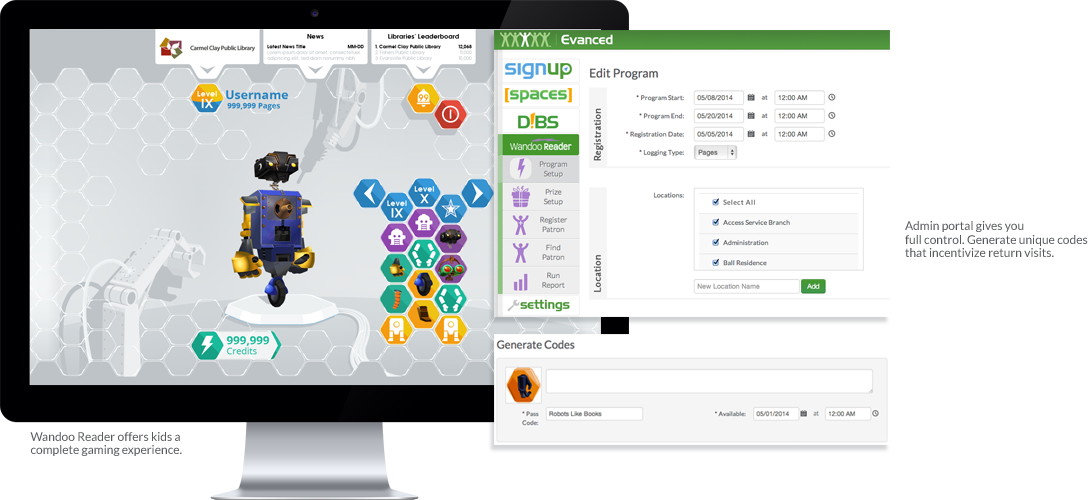
The next part of our day was looking at the landscape of Evanced.  Matt Sheley, Vice President of Evanced, shared the journey that the company took in arriving at Wandoo Planet and Wandoo Reader as solutions to a challenge.  The company looked at reading data that showed a population of students who weren’t reading beyond elementary grades.  They wanted to develop a tool that connected learners with materials that resonated with their interests in the hopes that it would grow them into lifelong learners and readers.  It was truly amazing to see the process from notes in a journal to the tool that we are using today.

photo 1

During lunch, we got to view Wandoo Reader, which is primarily focused on public libraries for now, but we had the opportunity to brainstorm what this tool might look like within a school.


To me, one of the most interesting conversations centered on collaboration between school and public libraries.  While we acknowledged the importance of data confidentiality, we also considered how powerful it would be if school and public libraries could share data.  Since students mostly read based on their interests during the summer, being able to see that data as a school librarians would help us improve our collections to match reader interests as well as advise our library members on next reads.

We also got a chance to walk around the Evanced office.  Some parts were very quiet with coders at work.  We also saw some of the displays that were taken to schools and conferences.

photo 2 (3)

Some Takeaways from Think Tank Part 2:

  • In our libraries and in our schools, we should take time to identify the major challenges that we face.  Rather than try to “fix” them all at once, we should select the one(s) we want to focus on and think beyond just the next steps or even the “research-based” strategies that we always turn to.  While these are certainly things to consider, we should also give ourselves permission to dream and create something entirely new that we build together as we go.  It should be a solution that truly matches the needs of the learners involved and pierces to the root of the challenge.
  • We should never feel done.  I could tell that Evanced is the kind of company that doesn’t put out a product and say “This is it. Take it or leave it.”  They constantly listen, fine tune, and add new features that respond to the needs of the users.  Isn’t that what we should be doing in our libraries and schools?  We are never done.

Our day ended with “Our Whys”.  We each took time to reflect on why we do the work that we do in school libraries.  It was a mixture of the #whylib conversations that took Twitter by storm in April and a series of short TED Talks.   It was very intimidating to me to go last during this sharing because I was blown away by the whys that my colleagues shared.  Our whys included keeping students at the heart of what we do, empowering student voices in the global community, creating a participatory culture that gives all students an opportunity to contribute, and listening to each student that enters our doors and allowing the library to be a home within our buildings.  If these statements had been recorded, I think I would listen to them every day on the way to work to frame my day.

photo 3 (3)

Some Takeaways from Think Tank Part 3:

  • We each need to be able to share our “why”.  It reminds us why we come to work every day.  It focuses the hundreds of decisions that we make on a daily basis.
  • Again, we need to share the work that we do within our libraries and within that sharing we need to embed our why.  It needs to shine through in the successes and the failures that we share.  When it does, it becomes one of our greatest advocacy tools.

I went to Indiana thinking that I was just going to give a company feedback to improve a tool that they had created and get to hangout with some of my closest professional learning network.  However, I realized that this was much more.  This was about thinking big, dreaming big, and (since I’m Googlified) solving for X through moonshot thinking.

The people at Evanced are listening.  They are dreaming.  They are searching for solutions to some of our biggest challenges.  This was such a rewarding experience, and I’m thankful to all of the people at Evanced for this opportunity.  I look forward to many more conversations in the future.


Book Tasting

Recently I saw my fellow colleague, Buffy Hamilton, talk about “book tastings” in the Unquiet Library.  Just the words “book tasting” sparked a plan to share books with our students that they might normally miss on the media center shelves.  I often see students picking the same kinds of books:  comics, football, sharks, princesses, etc.  While I think that is completely ok for them to read, I do think it is important to explore other genres and push yourself as a reader.  I offered teachers the opportunity to bring their classes to the media center for a book tasting to allow students to see several books in a short amount of time in order to find something new.

Today, Ms O’Prey brought the first group of 5th graders.  We set the media center tables with flowers, turned on some jazz and classical music, and placed “menus” and books and pencils at each seat.  I did a quick intro and explained to them that they would have between 2-3 minutes with a book.  Their job was to read some of the book: the back cover, the first pages, etc.  Then, on their menu, which was a list of all the books, they had to make notes about the books that they experienced.  This could range from a frowny face for a book that was just terrible to a longer description of why the book was a good match for them.

Students chose their first place at the tables.  From there, students spent 2-3 minutes with a book before hearing a train whistle blow.  At that time, they passed the book to the next person at the table and started the process again.  We immediately noticed how engaged students were in the process.  It was fast-paced and fun, and they were eager to see what they got.  We did run into some students who had already read the book they received, so we placed replacement stacks in the middle of each table.  Students could swap a book out if they had already read it.  I circulated and had a few conversations with students or redirected them if they were off track.  Periodically, I checked in with the whole group and got a feel for how the time was working for them, whether or not they had found a book they were interested in, and if they had found a book they couldn’t wait to get rid of.

As our time came to an end, I asked them to revisit their menu and choose their top 3 books.  We spread the books out on the tables.  Each student walked to their top pick.  If they were the only person there, they checked out that book.  If there were several people, they negotiated and some moved on to other books.  In the end, every student left with one new book and several left with more than one.

I was pleased to see books leave the media center that are new and have not circulated as much as I would like them to.  I told the students that I would check back in with them to see how the books were going.  Before they left, a few students recorded why they chose the books that they chose.  I have 2 more 5th grade classes coming to do this, and all of the 4th grade will be coming to do “author tastings” for author studies they will do at the end of the year.

Wonder is Truly Wonderful!

I started hearing about the book Wonder by R.J. Palacio a few months ago thanks to Mr. Schu at Watch. Connect. Read.  The more I heard him (and others) begin to talk about the power of this book, the more I wanted to read it.  I was very excited when Mr. Schu gave away some Advanced Reader Copies of the book on his blog.  I’m not usually a lucky person, but apparently I was meant to get a copy of this book because I won the drawing.  Also, as luck would have it, I got sick on my birthday and got to stay home from school.  During my day of silence, I finished the whole book.

I don’t even know how to begin describing this book.  It’s so much more than a book; it’s an experience of immersing yourself in the shoes of someone so unlike yourself.  It’s an adventure, a journey.  The main character August Pullman (Auggie) is born with a facial deformity, and as he says, “Whatever you’re thinking, it’s probably worse.”  Up until now, Auggie has been homeschooled, but he’s taking the leap of moving into a new school and all of the challenges that come with making friends, attending a formal school, and more, but he faces all with this with a major difference that he was born with.

R.J. Palacio tells this story from multiple perspectives.  I’ve come to realize that these kinds of books are among my favorites.  I love how the same situations are viewed completely different when seen through the eyes of several people and how individual stories weave together to tell a whole story.  The story starts from Auggie’s perspective, and I couldn’t help but want to reach out and give Auggie a hug.  All of my problems in life seemed so small and insignificant after viewing the world through Auggie.  He’s brave, smart, and funny.  I found myself wanting to spend more time with him, so I was a little sad when the book switched perspectives, but it didn’t take long for me to be glad that it did.  I liked getting inside the other characters’ heads and understanding why they made the choices that they made.  I easily made connections with them when I’ve been in similar situations where someone had a facial deformity.  I was reminded of when my wife and I were seated with a man who had a facial deformity on our 7 day cruise.  Every night, we sat with him and his wife and enjoyed some great conversation, and we didn’t once talk about the deformity.  It was a challenge, but I couldn’t help but think how he probably had to explain his face to every person he came in contact with and how nice it might be to just sit and have some normal conversation.  I was glad that Auggie met some of these kinds of characters in the book.

I know great things are ahead for this book.  It’s early in the year, but this is a standout book that is a must-read.  I’ve already ordered our copy for the media center and can’t wait to share it with students.  In the spirit of Mr. Schu and others who are paying this book forward, I’m giving away my copy to a teacher in our school.  I can’t wait to hear what the class has to say about the book!