A Little Augmented Reality and Zombie Math with 1st Grade

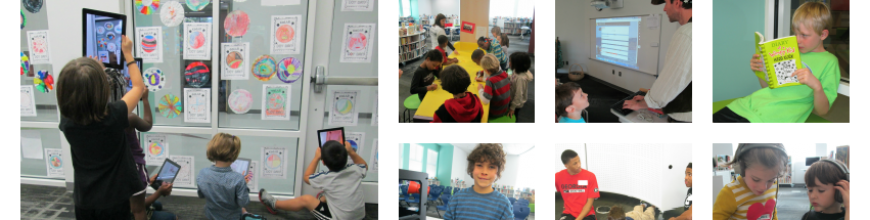
IMG_1842A few weeks ago, Em Smith Headley, 1st grade teacher, asked if I could help with their math standards using the iPads.  They have been working on using a variety of strategies to solve basic addition and subtraction problems.

I pulled together just a few iPad apps for our time together that addressed basic addition and subtraction facts.  I decided to use:

  • Fetch Lunch Rush: an augmented reality app that combines basic addition/subtraction, missing addends, racing, and augmented reality!
  • Math Zombies:  a racing app that gives basic addition/subtraction problems along with double digit math to race against the ever-approaching zombies.  Correct answers knock them out of the way.
  • Candy Count:  a sorting app that allows kids to sort candy by color and then asks several math questions about the candy in each bag.
  • iXL: an app with multiple grade levels which gives standard problems and allows kids to type an answer.

IMG_1846

I had student helpers make a 1st grade math folder on the iPads so that students could easily get to the apps.  We looked at the standard and students brainstormed several strategies that they currently use for solving math problems.  Things such as:

  • number lines
  • draw a picture
  • count up or count back
  • manipulatives
  • etc.

I reminded them that these same strategies come into play when we do math digitally and sometimes the app even provides some strategies for you with hints.  I did not tell students how to play every app because they were perfectly capable of figuring that out on their own.  I spent my time helping students think about strategy and encouraging students to help one another figure out the technical details of how the games worked.  Of course, I helped students who had technical questions, too, but that wasn’t my main focus as the teacher.

Students were bursting with energy during this.  Whether we worked for 25 minutes or 40 minutes, they were extremely focused.  They were free to move in and out of the apps as needed.  We were also able to differentiate for students who needed problems that were more challenging or problems with more basic  features.

At the close, students gave some feedback on what they liked about each app.  Math Zombies and Fetch Lunch Rush was by far the favorite, and they begged to get to do this again in their classroom or the library.


First Grade Google Form Choose Your Own Adventure

IMG_0050A small group of five 1st graders have worked with me during their writing time to create a Google Form Choose Your Own Adventure.  This year, some 4th graders tried this with some social studies standards.  These 1st graders were free to write about anything that they wanted to.  We met during 4 one-hour sessions that looked something like this:

Session 1:  I showed a completed Google Form Choose Your Own Adventure as a model.  Then, I showed the first steps of creating the story which were to create a title, a beginning, and the first 2 choices the reader had to make.

Session 2:  We made new pages for each of our 2 choices and created 2 new choices for each of those choices.  We linked the choices from the beginning of the story to the correct pages.IMG_0049

Session 3:  We made 4 endings for each of our choices from the middle of the story.  We also made a “The End” page.  We linked each choice to its correct page.

Session 4:  Students used Google to correct spelling, added details to their stories, traded computers with a friend to test their story out, chose a theme for their form, and emailed their final form to me for this post.

IMG_0048These students needed a lot of assistance during this project, so I feel like this is something that would work better in small group settings with adult support for younger students.  I do think that the structure of these 4 sessions was very obtainable for these students and 1 adult.  These students now have a lot of expertise that they can now share with students in their class.  I’m not sure that they could fully create one of these on their own yet, but they definitely developed their skills in Google docs and forms.


You can read their stories here:

The Apple and the Chocolate Trainer by Kyusung

The Clouds by Katie

The Fairy by Adaline

Ninjago by Bo

This story was still in progress at the time of this post:

Tinya the Teacher Fairy by Carinne


Fetch! Lunch Rush! App

Recently, on one of my favorite blogs, Free Technology for Teachers, Richard Byrne featured the app Fetch! Lunch Rush! for iPhone (also can be for iPad).   I immediately downloaded it, played around with it, and loved it.  I emailed all lower grade teachers to see if it might benefit their students with practicing some basic math facts, and the entire 1st grade team signed up to give it a try.  I printed out the cards  and posted them around the media center so that the game took on a true scavenger hunt feel.  The basics of the game are that you have basic math facts that add or subtract up to 10.  You have 10 printed cards with numbers and symbols on them to post around the room.  The app gives you a fact, you find the answer, you point the iPad at the picture, a picture of sushi appears on your screen, and you tap it to send it to lunch.  The app times how long it takes to answer the problems and increases in difficulty as accuracy and speed increase.

Students began on the carpet for a very brief demo of how the app worked.  Some students were paired together on 1 iPad (up to 4 players can play on 1 device).  Other students worked alone.  It was amazing to watch how active the students were.  They were scurrying about the media center looking for answers, pointing their iPads at the answer, tapping the augmented reality sushi, and moving on to the next problem.  Along the way, students got problems that were challenging to them.  The teacher and I gave them tangible objects to help them (fingers, popsicle sticks, markers, etc).  They stopped on the floor or at tables to figure out the answer before moving to find the card on the wall.  Students also began to get missing integer problems like 3 + ____ = 9.  These were the most challenging for first graders, but the challenge didn’t stop them.  They were eager to get an answer and continue the game.  

This app pulled together so many great learning pieces for students.  There was gaming, movement, problem solving, the cool factor, and technology.  The teacher made observations and then went back to the classroom to practice more strategies that will help students develop their math fact fluency.  I hope more apps like this one cross our path because it was fun, engaging, and took boring math fact practice to a whole new level!

This slideshow requires JavaScript.


Math Buddies Project

Today I had a wonderful time collaborating with Mrs. Mullins, Mrs. Maher, and their 5th grade/1st grade buddy partners.  The first grade teachers has noted that the 1st graders are being challenged by math word problems, particularly those that they write themselves.  Most of the students get the basic information of the problem down, but they forget to ask a question at the end and are often unsure of how to answer the problem.  The 5th grade buddies have been supporting the 1st grade students in this challenge.

Today, all of the buddies came to the library.  We began on the carpet where I read aloud the book Elevator Magic by Stuart J. Murphy.  When each subtraction scenario appeared in the story, I paused and the 5th grade buddies worked with the 1st grade buddies to figure out the problem.  We pinpointed the information that was provided, identified the question that was being asked, and vocalized our strategies for getting the answer.

Next, Mrs. Mullins demonstrated some math word problems on the smart board using the names of the first grade buddies.  Once again 5th graders and 1st graders worked together to find a solution.

Finally, buddies went to tables to craft their own word problems using any numbers and objects they wanted.  They were asked to jazz up their word problems as much as they wanted.

Mrs. Mullins, Mrs. Maher, and I all visited with buddies as they worked and listened to the many strategies that they were using.  They crafted a whole variety of problems that ranged from single digit problems to problems dealing with thousands.  Now, Mrs. Mullins plans to type up these problems and share them with the 1st grade teachers for use in class.

The buddies will return to the media center in January for another math experience with fractions.

This slideshow requires JavaScript.

First Grade Botanists

A first grade class has been studying plants and practicing being botanists with their student teacher.  Over the past few weeks, they’ve worked on a Photo Story of their learning.  They invite you to take a look at what they’ve done.

Stitching Stars Storytellers

As part of enrichment clusters this semester, I am working with a group of 9 kindergarten and first grade students to learn how to become storytellers.  This group has been fun, but it has come with many challenges as well.  Since most of these students are learning to read, they are unable to independently read most picture books or folktales.  They also began as a very shy group that was soft-spoken and quiet.

Here are some things that we have tried:

  • Watching videos of rambler storytellers from the Wren’s Nest and commenting on what we noticed that the storyteller did.
  • Listening to stories read aloud and discussing the kinds of expression that was used.
  • “Reading” a wordless picture book together very slowly and with great detail, and then working with partners to read other wordless books.
  • Modeling partner reading using Mo Willems’s Elephant and Piggie books and then practicing with a partner
  • Kim James from the Athens Public Library did a lap puppet show and an oral story with the students and then offered feedback as students practiced their own wordless picture book stories.

With all of these pieces, students are gaining confidence, and I’m noticing that they are developing their imagination, expression, and volume.  In the coming weeks, we will practice listening to stories and drawing pictures that will be cues to help us tell the stories.  In the end, the students have a goal of each telling a story at our enrichment fair in May.  Wish us luck!


This slideshow requires JavaScript.