Making Our Mark with Dot Day 2014 (and I hope well beyond)

Dot Day (42)

International Dot Day is one of our favorite days (weeks) of the year.  It gives us permission to be creative and see what we can do just by making a mark.  It also connects us with so many classrooms around the world.  Classes are always looking to connect on this day, and we have made many collaborative relationships with schools because of this one day of the year.

This year, we used Dot Day as a way to explore our goal of dreaming, tinkering, creating, and sharing.  We explored Google Drawing, which was a new tool for most students.  We used Dot Day as a time to tinker and see how Google Drawing functioned as well as how to collaborate on a drawing with another student or class.

We also used colAR mix again this year to make augmented reality dots.  This year, I encouraged students to think more globally as they made their dots by embracing the them of “making your mark on the world” that is the essence of The Dot.  Students were encouraged to design a dot that represented their talents, hopes, dreams, and passions.  I loved this new twist on a tool that we used last year because it revealed so many stories from students.  One student drew a picture of an airplane flying through the clouds because of his dream to be a pilot when he grows up.  Another student drew an astronaut and UFOs because of his desire to explore space.  Another drew her whole family because they are what she loves in life.  Some students chose to highlight their creativity as a way that they make their mark by designing unusual dots with their favorite colors.  These were empowering stories because they allowed students to have a voice to share something personal about themselves in a way that they might now have shown before.

One amazing thing that happened while students were using the colAR app was how they discovered different ways to scan their dot. It started out as what some people might see as a mistake.  A student’s hand was on top of their dot while they were scanning their image, and the hand became a part of the rotating sphere on the iPad screen.  This resulted in an uproar of excitement as sharing began and the idea spread like wildfire.  Soon students were trying to put their faces on their spinning spheres.  Others stacked towers of crayons on top of their dot and tried to see if that would scan into the 3D image.  All of this happened because of an opportunity to tinker.  When we give kids a space to explore, they figure out amazing things and they willingly share and teach others what they learned.  They get excited about their learning and they want to do more.  I bet that these students would have spent an extended period of time continuing to experiment with colAR mix to see what else they could figure out, and they would have done this without getting tired or bored.  These are the things that days like Dot Day reveal.

We had numerous Skype connections.  Each one had its own unique twists and conversations between students and teachers.  In many of these Skypes, we collaborated on a Google Drawing dots after reading the book.  This included dots with our friend Okle Miller in Tampa, Edie Crook in North Carolina, and Crystal Hendrix in North Carolina (just to name a few).  Sometimes this was live during a Google Hangout or Skype and other times it was after we disconnected.  One of our hangouts was a large hangout between Matthew Winner in Maryland, Nancy Jo Lambert in Texas, Donna MacDonald in Vermont, and Esther Uribe in Texas.  It was fun to read The Dot to students in so many states at one time, but what was even more fun was drawing with all of them at the same time!  We definitely did some tinkering with this one.  Many of us learned of the challenges of younger students but found ways to involved them even with computer-use difficulties.  The students loved seeing drawings “magically” appear on our shared dot.

Ramsey & Winner Dot

Our multi-school collaborative dot

With Jennifer Reed in Massachusetts, we accidentally deleted all of our work on our collaborative dot.  The kids were in a panic, but it was a fantastic opportunity to do an impromptu lesson on the power of revision history in Google Drive.  We were able to recover our work and learn an important trick.  We even talked about how revision history is one way that work is never deleted, which can be a positive but also a negative if you have written something that you wished you hadn’t.

Wright & Reeder Dot

Our dot with Jennifer Reed that was almost lost!

Mrs. Clarke’s class had a Skype connection, but we weren’t able to do a collaborative dot with our connecting class.  Instead, we split the class in half at our 2 projection boards and they created a dot together as a class.  They got just a bit competitive as they tried to cover up each other’s work, but even this was a great opportunity to talk about how to work with others on a doc without being disrespectful of the contributions.

Clarke & Lussier Dot

Mrs. Clarke’s class competitive dot

Some classes that we connected with had already spent a great deal of time being creative, and they shared with us dots that they are going to physically mail to us.  Jenny Lussier in Connecticut had colAR dots as well as Morse code greeting cards.  We can’t wait to decode what they say!  We also discovered with Jenny that there’s more than one version of The Dot floating around out there.

Cathy Potter’s students in Maine read the book Ish to our students and shared their own illustrations for the book.  We had a great conversation about the connections between both books.

Dot Day (60)

Students and teachers alike love this day, but I do leave this day with a wondering.  I’m thinking so much this year about global thinking and global collaboration.  This day is filled with thousands of Skype and Google Hangout connections around the world.  We connect.  We read.  We dream.  We create.  But then what?  We leave one another until the next big event.  I’m by no means being negative about Dot Day.  I’m a huge advocate, but I do wonder about why we don’t build upon these connections we make.  If we are really going to “make our mark” on the world, shouldn’t we be taking some actions together beyond connecting, reading, and creating?  I would like to gently nudge us all to think about this.  I’m just as guilty.  I connect every year and then I move on, but I can’t help but carry this on my mind, reflect on it, and consider what more we might do beyond today.  Think with me!  Let’s keep our dots connected.

Dot Day (43)


September 11th: A Global Perspective

September 11 (3)

Each year our 5th graders take an entire day to explore the tragic events of September 11, 2001.  Each year, the students become more and more removed from the topic because they weren’t even born at the time of the tragedy.  The events of September 11 and the impact they had on our war on terrorism are part of the 5th grade social studies standards, but we also spend a great deal of time at our school on social emotional learning and how we support one another in a community.

September 11 (22)

Each year I write a blog post about how we teach September 11th, and each year there is a new addition or a new angle in which to explore the day.  This year, students opened the day in their classrooms by talking about everyday heroes.  They shared where their own families work and how each of us can be an everyday hero.

September 11 (17)

Then, students split into 4 groups and rotated through 4 experiences every 30 minutes which were facilitated by me and the classroom teachers.

Experience 1:  Haiku poetry.  With Ms. Mullins, students learned about the unlikely heroes of the day including dogs.  They studied the poetry form of haiku and how a brief 3-line poem with 17 syllables can magically express a feeling or an image.  They focused their haiku on heroes.  They didn’t have to specifically write about the heroes of 9/11, but many chose to.

September 11 (28)

Experience 2:  Response to tragedy from afar.  With Ms. Selleck, students looked at how people around the country and the world responded to the tragic events of 9/11.  It was a time that people wanted to take action and do something to help.  Children wrote letters, drew pictures, and made cards.  The Maasai people of Africa offered 14 cows as a gift for America.  Ms. Selleck shared Carmen Agra Deedy’s story 14 Cows of America and students considered how people who weren’t even in our country wanted to help.  This posed an interesting question of how we might respond to the tragedies taking place every day in other countries.

September 11 (20)

Experience 3:  Heroes of 9/11.  There were so many heroes that stepped forward on 9/11 and many of those heroes lost their lives in the process.  At this experience, students took a look at many example of heroes and read the story Fireboat by Maira Kalman.  Students learned about this old fireboat first launched in 1931 and how it was called to duty on 9/11 to help pump water to fight the fires.  Students designed a drawing to represent the many heroes that took action on 9/11.

Experience 4: The events of 9/11.  This is the most sensitive of the experiences for students because we all react differently to seeing the tragedy of 9/11.  Over the years, I’ve developed a pathfinder of sites that explore 9/11 from multiple angles.  There are interactive timelines, eyewitness accounts, actual video footage of the day, oral histories of memories from victims’ family members, virtual tours of the memorials, and cartoon videos explaining the events in kid-friendly language.  We start with a video:

This video frames that on 9/11 we remember but we also take action to create good in the world.  I invite students to view the various resources and reflect on what they might do to create good instead of evil.  At the bottom of the pathfinder there is a padlet where students can record their actions that they want to take.  During this experience, I always tell students that they don’t have to watch any of the videos.  They can also take a break at any moment if the tragedy just becomes too much to handle.

This year, 2 new pieces were added to this experience.  First, Gretchen Thomas, a UGA teacher in instructional technology, brought one of her #EDIT2000 classes to support students.  This was a piece that I’ve always felt was missing from the pathfinder experience.  September 11th is such a heavy topic, and I do worry about how kids are processing the information.  With these UGA students, we were able to pair every 5th grader with a UGA student to have reflective conversation about each website, video, and story that students experienced.  UGA students shared their own understanding of 9/11 as well as their own memories of being in elementary school when it happened.
 

I’ve also been thinking a lot about global thinking, global collaboration, and global perspectives.  This year, I decided to make a Flipgrid well in advance of today.  Through social media, I’ve been sharing the Flipgrid in the hopes that multiple people will share their own perspectives of 9/11.  While there wasn’t an overwhelming response to share stories, the stories that were shared were powerful.  The students in Gretchen Thomas’s class shared their own memories of being in elementary school at the time.  These stories included very personal connections to the tragedy such as family members who were in New York on the day of the tragedy and a student coming into New York on a plane from another country and being diverted to Canada.  Several librarians stepped up to share stories as well.  Beth Miller of Georgia shared her story of working in the World Trade Center during the bombing in the 1990′s and how she had family and friends who were in the towers on 9/11.  Her family made it but several friends did not.  Elissa Malespina of New Jersey shared the story of her husband being in New York on 9/11.  He was on one of the last trains coming into the city.  It was chilling to think how many people have been affected by 9/11 in very personal ways.  Even if you don’t have a personal connection, there are many stories about where people were when the tragedy happened.  I wish that I could talk about every story on this Flipgrid because each one is meaningful in its own way.  Please take time to listen to these stories and feel free to add your own.

September 11 (25)

This Flipgrid was a part of the pathfinder but it was also a place that students recorded their own thoughts at the end of the day.  Students spent some time reflecting in classrooms.  Then, they came out into the 5th grade hallway with iPads to record their reflections on the Flipgrid.  Another of Gretchen’s UGA classes came to assist with this process.  I had instructions typed up with the Flipgrid code and we got as many students recorded as possible at the end of the day.  Students loved collaborating with students from UGA to create their videos.

I think that this project has such potential for a global collaborative project.  What would it be like if students in another country shared the tragedies taking place in their own countries?  What would happen if our students in the  US considered how they could respond to the tragedies taking place in other countries?  What are people’s perspectives on 9/11 from other countries around the world?  What do everyday heroes look like around the globe?

My hope is that this project can continue in some way this year.  If it doesn’t, I hope that next year’s layer that gets added on is developing a more global perspective on tragedies around our world and how we respond to those tragedies as a global society.


Developing Library Goals to Carry Into Every Collaborative Meeting

photo 2 photo 1

Last year, a book impacted my life, my library program, and found its way into so many conversations with students, teachers, and librarians.  “Expect the Miraculous” came to be our mantra in the Barrow Media Center thanks to Flora & Ulysses: The Illuminated Adventures by Kate DiCamillo.  It was all thanks to p. 130-131.

photo 3

This summer, as I sat down to develop our library program goals for the 2014-2015 school year, that mantra of expecting the miraculous everyday was still a big part of my thinking.  However, this summer I carried so much more with me as I reflected on goals.

I had my experiences and conversations with the #Wandoo5 at Evanced Games in Indianapolis.

photo 3 (3)


I had the moonshot thinking and action plan of the Google Teacher Academy and becoming a Google Certified Teacher.

graduation


I had the Invent to Learn Workshop with Sylvia Martinez and Gary Stager.

Photo credit: Sue Levine


I had numerous experiences at the ISTE 2014 conference including a zombie fighting keynote from Jennifer LaGarde, empowering talks from George Couros and Todd Nesloney, and inspiring keynotes from Ashley Judd and Kevin Carroll about the importance of each child’s story and the importance of play.

The more I reflected on my summer professional learning experiences the more I realized that I wanted this year’s goals to be different.  In the past, I’ve made big goals about developing the participatory culture in our library, but I’ve also made specific goals about the collection.  While the collection is important, it is not my primary focus for the library program.  I was reminded of a question in Jennifer LaGarde’s keynote about the Dewey decimal system and her answer of “who cares”.  Who cares if I have specific goals about the library collection?  What cares if the 300′s have the recommended number of books?  Who cares what the average age of the biographies is?  The heart of the program isn’t the physical collection.  The heart of the program is the students, the teachers, the families, and the community.  The heart of the program is the opportunities that they have through the library.  Now, I’m not saying that I’m abandoning the collection or that I don’t have goals about the collection.  It’s just that my primary goals of the library aren’t about the collection.

I want goals that I can carry with me into every collaborative meeting that I attend.  I want goals that I can put up on the walls of the library and add tangible evidence throughout the year of how they are impacting the students, teachers, and families in our school.  I want goals that support our school and district goals as well as reflect what is being talked about on a global level.

This week, I will share these goals with our faculty during pre-planning, but they’ve already faced their first test.  During our first day of pre-planning our principal set the stage for our year.  I must say that it was one of the most inspiring opening days that I’ve ever been a part of because it wasn’t filled with duties and responsibilities, mandates, and daunting changes.  Of course, all of those things  will be present this year, but our principal chose to focus on how we can value each child’s story, how we can add to and enhance that story by what we offer at school, and how we can develop a vision and mission for our school that represents what we truly believe in education.  As I listened and as I talked with other teachers, I was already carrying my goals with me, and I must say that I felt really good about the 4 goals that I’ve chosen.

These are the goals that are based on the themes that consistently surfaced in all of my reading, professional learning, conversations, and reflections.

Goal 1:  To provide students, teachers, and families opportunities to dream, tinker, create, and share

blokify printing (2)

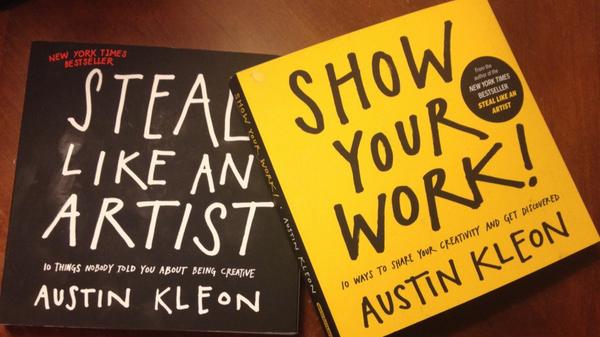
I chose these verbs carefully because I think that the order matters.  So often, we feel the time crunch in education and I think we often jump to having students make something with so many detailed requirements that they don’t have time to dream about what they hope they could make or have time to mess around, fail, and learn from those failures.  As I plan projects with teachers this year, I want to intentionally plan spaces for students to pause and wonder and have time to explore before they actually create a final product that is shared with an authentic audience.  I want us to think carefully about how we “show our work” just as Austin Kleon outlines in his books.  He says, “If your work isn’t online, it doesn’t exist.”  I’ll be thinking carefully about how we give students opportunities to create and also how they share their process as well as their final product.

Within this goal, I have subgoals about the number of large-scale projects I will do with each grade level, the development of our library makerspace, the collaborative relationships with our community makerspace and tech startup, and embedded digital citizenship.

Goal 2:  To engage in global thinking and global collaboration

Global TL logo

I can’t even count the number of times that global thinking and collaboration came up this summer.  I feel like so many people around the world are primed and ready for this endeavor during the upcoming year.  Last year, our library was more connected than it has ever been through authors, guest speakers, reading events, and peer feedback through Skype and Google Hangouts.  Even though we felt connected, most of our work was projects or single connections.  I would love to see global thinking and collaboration become more evident in what we do through long-term collaborative relationships around the globe and authentic questions and projects that matter to the world.  Within this goal are the many networks that I will be a part of this year including GlobalTL, Connected Classroom, Skype in the Classroom, and my Twitter PLN.  I’m inspired by the work of Sylvia Rosenthal Tolisano and will look at her work as we plan this year.

As teachers and I plan this year, we will ask ourselves how we are being global thinkers and how we are connecting our students beyond the walls of our school.

Goal 3:  To empower student voice

IMG_3479

When I thought about this goal, I was reminded of many stories shared by George Couros at ISTE including the story of a little boy who made a video where he overjoyed by getting one “like” on a social media post.  I was reminded of Todd Nesloney sharing about his math fair and how he asked students to “wow” him by showing their math knowledge.  Students did more that “wow” him.  They shared their passions in life, involved their families, and were empowered.  I was reminded of how we all want to be heard and feel like we’ve made a difference.  As I plan with teachers this year, I want to ask how we are empowering each student by allowing them to share their passions and feel that their voice is heard.  In the library, I will continue to explore this as well by giving students opportunity to document our year, make decisions about library resources, share their passions through contests and displays, pass on their expertise through co-teaching experiences, and listening closely for opportunities I don’t even know about.

Goal 4:  To support the reading habits and curiosities of students, teachers, and families

It’s no secret that the more you read the better reader you become.  You of course need to have the skills and strategies to accompany that time commitment.  You also need access to reading that matters to you.  This year I want to be more intentional about supporting reading curiosities to match students, teachers, and families to the kinds of stories and information they are looking for.  I also want to be more intentional about documenting that commitment to reading.  Our library is not the only source of reading materials, so I want to continue to build a collaborative relationship with the public library, local bookstores, and other community resources to all work together toward a common goal.

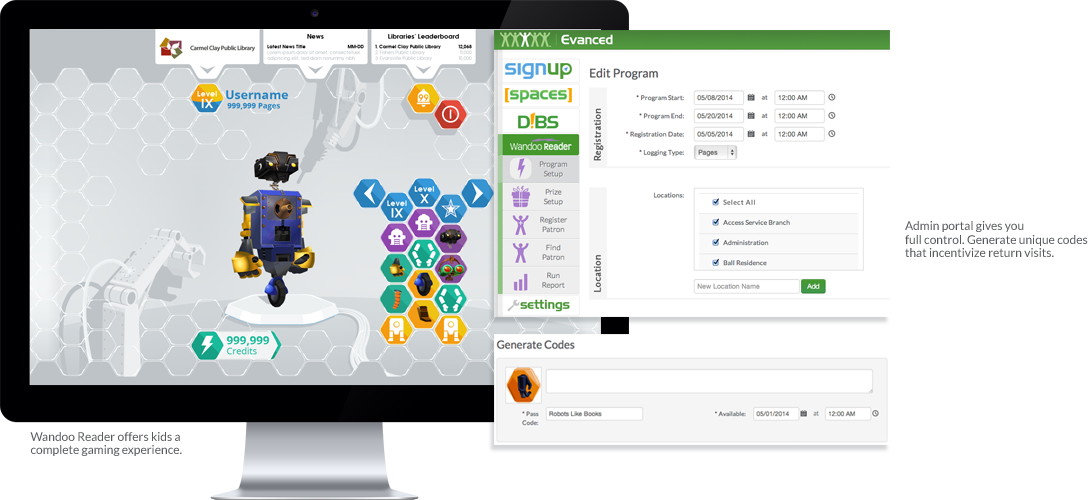
This year, we will explore an Evanced tool called Wandoo Reader.  This tool will give students a portal for documenting their reading lives through tracking book titles and minutes read.  Along the way, there will be challenges issued to students, and within Wandoo Reader, they will earn pieces to a robot that they will customize.  I hope that this tool will offer a level of engagement for tracking reading as well as encourage students to spend more time reading in multiple ways from multiple locations.

IMG_3035


Our planning will begin this week and I look forward to carrying these goals with me, trying them out, and see what miraculous things happen this school year.

What are YOUR library goals?  I invite you to think about them in new ways and share.


Taking Time to Say Thank You

Thank You (1)As a teacher librarian, I give a lot of my time to students, teachers, and families just as every educator does.  The rewards of teaching for me are seeing the brilliant work that students create and watching that work reach out and connect to a global audience.  I love seeing the excitement from kids as they meet an author in person or over Skype and how that one moment inspires them to read a new book or to write a new story.

When you actually get a verbal or a written thank you, it means a lot.  Those thank you’s are a reminder of how much students appreciate the opportunities that they have in the library, and they are a great pick-me-up on days where you feel like nothing is going right.  Thank you’s also give me an insight into what kids take away from the experiences in the library and what they are curious about.  This kind of feedback informs future planning to create experiences that kids are excited to be a part of.

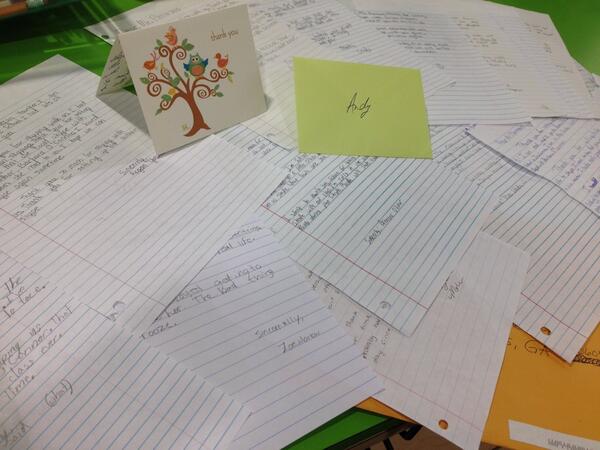
This year during Read Across America and World Read Aloud Day, we held 36 skype sessions connecting with 50 locations, 22 states, 2 countries, and 9 authors.  I received a whole pack of thank you letters from Caitlin Ramseyer’s class at our school.  I put all of those letters up on the windows of the library for everyone to see and to validate the students’ hard work in writing the letters.

Yesterday, I got a big pack of thank you’s from Sherry Gick’s 6th graders in Rossville, Indiana.  These students shared a Skype session with us and author, Barbara O’Connor.  I loved seeing 6th grade writing, and it was so interesting to see what they valued in the skype experience.

  • I love when we get to skype with classes because it is a cool experience to meet other kids and classes in different states.
  • It was fun to see the author in real life
  • That was the best reading class ever
  • Even though I don’t like writing, I LOVE reading.  After that skype, I now like writing better.
  • We just finished Chapter 1 of How to Steal a Dog so hearing Chapter 2 was a bonus.
  • I wish we could do this again.
  • If we could skype again, it would be even better.
  • Your class had some interesting questions to ask the author.
  • I’ve always wanted to Skype with an author.  I finally did!
  • Since you are in a different state, it is awesome to see the differences in our classes and the similarities too.

There were also several sentences that made me smile

  • You class looked very nice and it seemed like they are good kids
  • Thank you again for giving us your time to Skype because it was probably hard to find time during your day since you’re a librarian.
  • I think it would be fun to live in Georgia.
  • Thank you for skyping with us.  I think we should meet in person next time!
  • So, I hear you are a librarian.  Mrs. Gick is too!
  • Once again I want to thank you for everything you have done!  Since you are a librarian, this must have been hard enough!
  • I love your library setup (from what I could see)
  • It’s always frun skying with another class because we get to see what kind of weather you guys are having.
  • You seem like a nice teacher.
  • You seem like a cool teacher.


They also asked me some questions:

  • What book are you reading now?  Lug, Dawn of the Ice Age: How One Small Boy Saved Our Big, Dumb Species
  • What is the name of your school? David C. Barrow Elementary
  • How big is your library?  Big.  I don’t know the square footage, but right now we have the book fair in half of the library and there is still room to have all of the books and spaces to work on the other side.
  • What is your favorite book?  Anything by Kate DiCamillo
  • Do you have swamps?  Not in Athens, but we have the Okefenokee Swamp in south Georgia
  • Did you like Mrs. O’Connor’s book?  I love her writing, especially How to Steal a Dog
  • Do you like animals?  Yes.  I have a dog and 3 cats.  My favorite animal is a killer whale.
  • What kind of books do you like to read?  Love realistic fiction with a bit of magic in them.  Also fantasy and poetry.
  • Do you eat gator?  Not on a regular basis.  I have tasted gator but don’t really like it.  
  • Do you know any good biographies?  I love Tanya Lee Stone’s biographies, especially Almost Astronauts
  • Wasn’t Barbara O’Connor awesome?  Yes!

This experience reminded me of the importance of slowing down to say thank you. Our school felt so connected to so many people during the week of World Read Aloud Day.  I truly do thank each librarian, author, and student that we connected to that week.  You enriched our lives in so many ways.  Thank you!


Expecting the Miraculous Now and in the New Year

photo (4)Over the summer of 2013, I was fortunate enough to receive an advance reader copy of Flora & Ulysses:  The Illuminated Adventures by Kate DiCamillo.  She is by far one of favorite authors because her words always seem to speak to me in some way beyond just the story.  On p. 130, I came across a quote that I have honestly carried with me in my heart and mind since reading it.  In fact, it has become a motto that I embrace in our school library because it exemplifies the brand that our library represents.

“All things are possible,” said Dr. Meescham.  “When I was a girl in Blundermeecen, the miraculous happened every day.  Or every third day.  Actually, sometimes it did not happen at all, even on the third day.  But still, we expected it.  You see what I’m saying?  Even when it didn’t happen, we were expecting it.  We knew the miraculous would come.” ~Kate DiCamillo

Expect the miraculous.  It’s the phrase that I cheezily say to myself as I enter school each day.  It’s what I remind myself of when I sit down to plan with teachers.  It’s what I whisper to myself in the midst of a technology fail.  It’s what came out of my mouth in a recent interview with School Library Journal:

For wary school librarians, Plemmons adds, “My philosophy is, if we don’t expect miraculous things to happen in our libraries, then we’re just limiting ourselves. Why totally shut a door when we don’t know where it leads to?”

I don’t want to put limits on what kids are allowed to do just because I might not be an expert in a particular tool or concept.  I’m willing to try anything new with any age of students and expect that something great will happen even if it’s not what I imagined happening in my head.  In Invent to Learn, Sylvia Martinez and Gary Stager say,

“It is unacceptable and unnecessary to deny children the opportunity to work on something they are passionate about because the teacher is not an expert in that particular field.”

Looking back through my posts of 2013, I see so many incredible things that happened in our library because we (myself, students, teachers, families, connected educators, and special guests) expected the miraculous.  Here are just a few:

  • 5th graders working together to design, plan, persuade, collect, paint, and dedicate during the Little Free Library project.  We now have 2 Little Free Libraries thanks to their hard work.  We went into the project with so many unknowns, but we always expected that the libraries would exist in our community.  Check out the posts!
  • 2nd graders developing their writing skills through blogging and connecting with students in Van Meter, Iowa.  This project included a miraculous connection with author/illustrator Jenny Sue Kostecki-Shaw.  Check out the posts!  Post 1  Post 2   Post 3

  • 3rd graders engaging in action research to solve a real-world problem at our school.  Their investigations included webcam observations, indoor and outdoor observation, skyping with Cornell University and a former Barrow Buddy via Skype, and email communication with other experts.  Their work resulted in many attempts at saving birds from crashing into our school windows.  Post 1  Post 2
  • 1st graders using Twitter to write persuasive messages about our environment.  Check out the post!
  • Multiple connections for special events like World Read Aloud Day, World Book Night, Dia de los Ninos, Read for the Record, and Talk Like a Pirate Day.
  • Students purchasing books for our library with their very own student book budgets.  Check out the post!

  • Students from throughout the school crowd-sourcing a poem using Google Forms for Poem In Your Pocket Day.  Check out the post!
  • Our annual Poem In Your Pocket Days live on Adobe Connect with viewers in multiple states and countries.  Post 1   Post 2
  • Kindergarten students becoming experts inTux Paint and making an informational video to teach others to use the program.  They even connected with students in Van Meter, Iowa to share their expertise.  Post 1  Post 2

  • Moving into a brand new library and working together to learn how to use it.  Check out the post!
  • The entire 4th grade working together in the library over several days to research explorers and Native Americans as well as challenge their thinking about heroes and villains.  Check out the post!
  • 2nd graders using Thinglink to publish monster stories.  Check out the post!
  • A Picture Book Month Smackdown with 2 authors and schools in 5 different states.  Check out the post!

  • After our district decided not to buy a 3D printer, we continued expecting the miraculous.  Miraculously, Donors Choose and Makerbot created a partnership and overnight a 3D printer was funded for our library!  Check out the post!
  • Classes in every grade level committed to exploring computer programming during the Hour of Code.  I’m expecting more miraculous things to come out of this one hour experience.  Post 1  Post 2
  • Our very first student-made design was printed on our 3D printer.  Grant and I expected the miraculous (even though we were prepared for failure).  Check out the post!

1st print (18)

When we give kids the space to explore, the tools to create, the connections to expertise and collaboration, and a global audience to share with, miraculous things will happen.  I know that not everyone believes this.  Recently, an article was published in the Athens Banner Herald highlighting out Hour of Code activities.  In the article, I was quoted saying:

“I encourage them to think about how coders aren’t afraid to make mistakes,” Plemmons said. And when they do make a mistake, they work with their peers to fix it.

Even though I try to avoid reading online comments (and I wish I had used the word failure instead of mistake), I was disturbed by one commenter’s post.  She said:

Such a lax attitude is not acceptable in my book. I am afraid to make mistakes in my work so I make sure all possibilities are considered and all details are addressed and included. I also make great effort to anticipate any questions my clients may have and am ready with an answer before I sit down at a meeting. I don’t need to ask others to help me fix any problems; I’ve already fixed them.

It’s good to tell kids to relax and not worry about making a mistake as they learn, but that real work for hire must be near perfect without wasting a lot of people’s time or your own.

The most disturbing part of this comment to me was the notion that giving kids space to fail, step back, re-evaluate, and try again is having a lax attitude.  Many major companies encourage their employees to fail early and fail often. This allows their employees the freedom to be innovative and take risks knowing that those risks are what unveil the latest great ideas. By failing early, learning from failure, and fine tuning their products, companies are able to release the best quality product that they can. In the digital world, companies continue to listen to the consumer and push out updates to improve any mistakes or ideas that they missed. This is the same kind of situation with students. They aren’t publishing final products online that are full of mistakes. Rather, they are attempting to make the computer do what they want it to do, trying some code, seeing what works and what doesn’t, and fine tuning their work. No one sits down and makes a perfect product without first failing.  Expecting the miraculous certainly doesn’t mean that you are expecting things to be perfect on the first try.

I was reminded of the importance of failure when I was recently reading Presentation Zen by Garr Reynolds.  Reynolds says:

“The fear of making a mistake, risking an error, or being told you are wrong is constantly with us. And that’s a shame. Making mistakes is not the same thing as being creative, but if you are not willing to make mistakes, then it is impossible to be truly creative. If your state of mind is coming from a place of fear and risk avoidance, then you will always settle for the safe solutions–the solutions already applied many times before.”

“Children are naturally creative, playful, and experimental. If you ask me, we were the most human when we were young kids. We worked on our art, sometimes for hours without a break, because it was in us, although we didn’t intellectualize it. As we got older, fears crept in along with doubts, self censoring, and overthinking.”

In 2014, I am going to continue expecting the miraculous with my students, my collaborators, my families, and my peers.  We will embrace our failures, learn from them, and continue to create innovative work together.

I am going to start 2014 by asking my students, “What miraculous things do you expect in 2014?”  They will record their responses on a Flipgrid.  I invite you to add your own expectations to the same Flipgrid.  Go ahead.  Give it a try.  Expect the miraculous.

Day 2 (3)